March 4, 2012

Pirates of Somalia


Somali pirates continue their attacks against international ships in and around the Gulf of Aden, despite the deterrent of stepped-up international naval escorts and patrols - and the increased failure rate of their attacks. Under agreements with Somalia, the U.N, and each other, ships belonging to fifteen countries now patrol the area. Somali pirates - who have won themselves nearly $200 million in ransom since early 2008 - are being captured more frequently now, and handed over to authorities in Kenya, Yemen and Somalia for trial. Collected here are some recent photos of piracy off the coast of Somalia, and the international efforts to rein it in. (30 photos total)
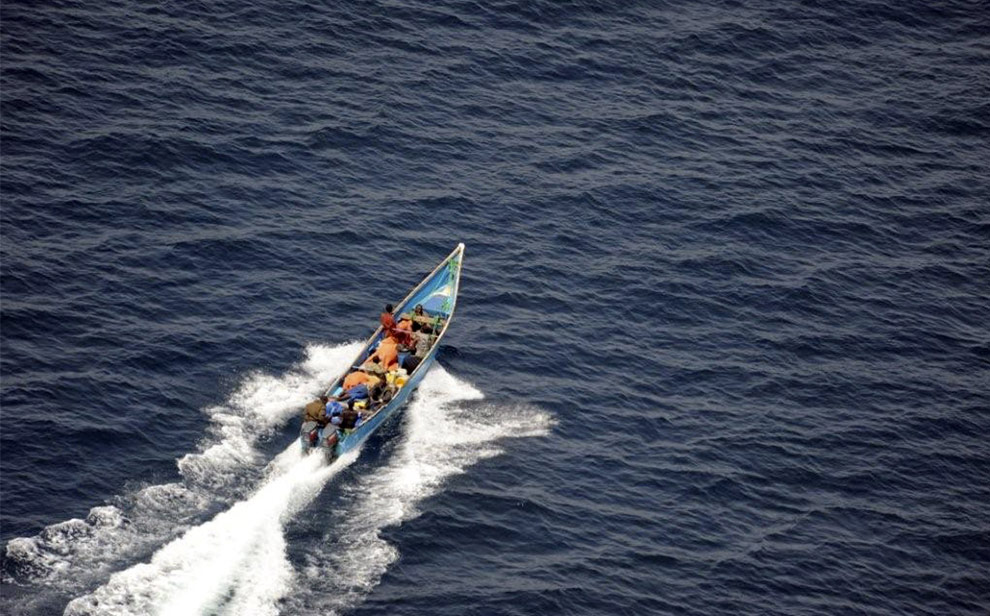

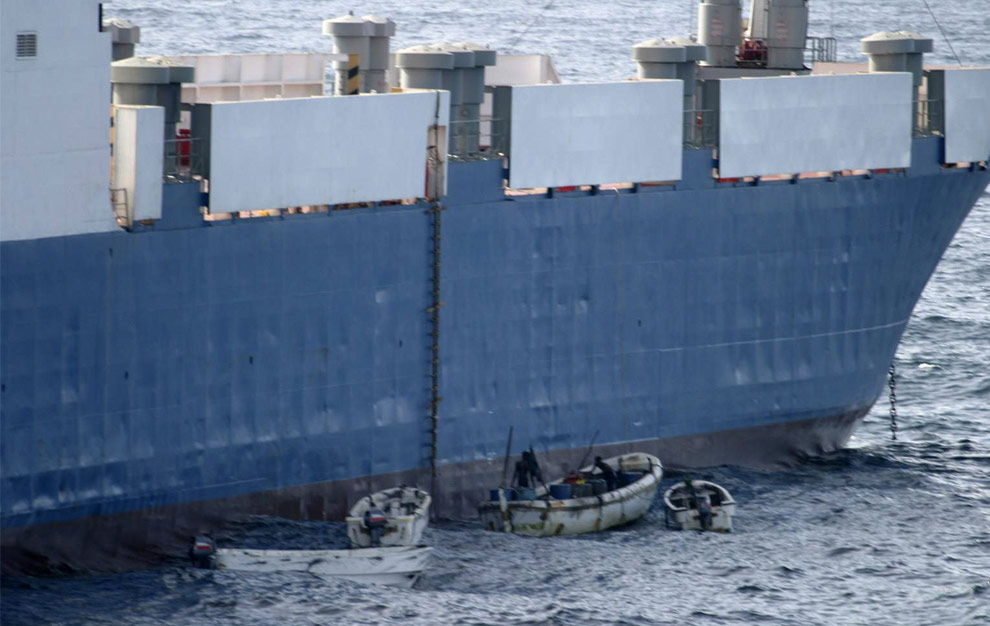
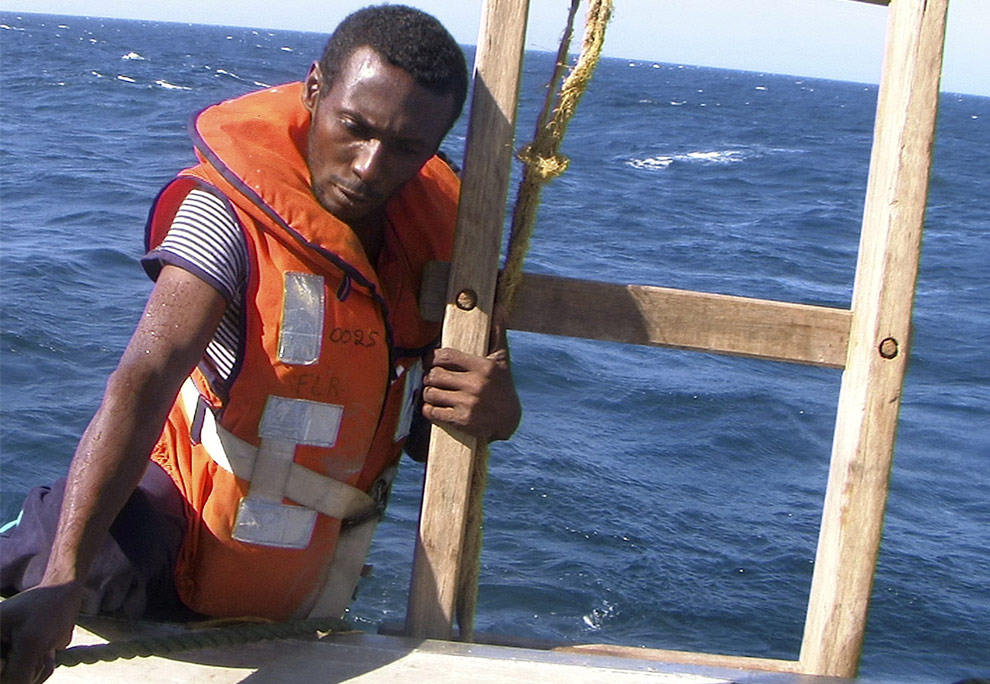
Pirates flee from the German navy as the frigate Rheinland-Pfalz intercepted them in the Gulf of Aden off Somalia's coast on March 3, 2009. The German navy detained nine people on March 3, 2009 after they tried to attack a German merchant ship, German media reported. (REUTERS/Bundeswehr)

2
This handout photo shows Somali pirates hijacking the MV Faina, a cargo ship owned and operated by Kaalbye Shipping Ukraine on September 25, 2008. The pirates ultimately released the MV Faina and its cargo of 33 Soviet-era T-72 tanks plus other weapons on February 5, 2009 following a ransom payment of $3.2 million, a local man who helped negotiate the deal said. (REUTERS/U.S. Naval Forces Central Command Public Affairs/Handout/Files) #

3
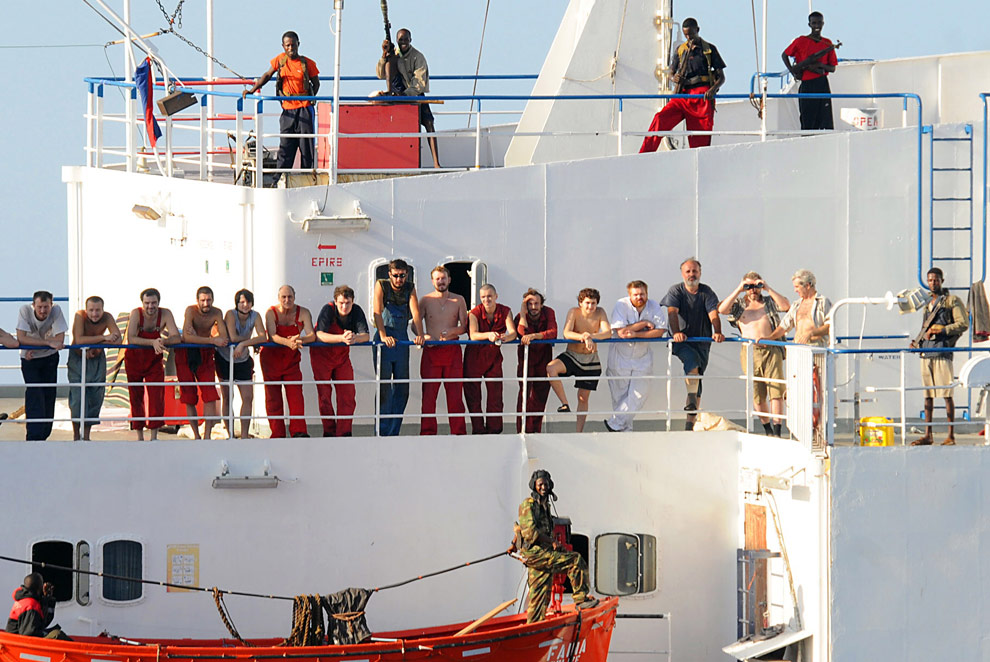
In this photo released by the United States Navy, Somali pirates holding the merchant vessel MV Faina stand on the deck of the ship after a U.S. Navy request to check on the health and welfare of the ship's crew in the Indian Ocean off the coast of Somalia. (AP Photo/U.S.Navy, Petty Officer Jason Zalasky) #
4
The crew of the hijacked Ukrainian merchant vessel MV Faina stand on the deck, under the watch of armed Somali pirates on November 9 after a US Navy request to check on their health and welfare, at sea off the coast of Somalia. (HO/AFP/Getty Images) #

5
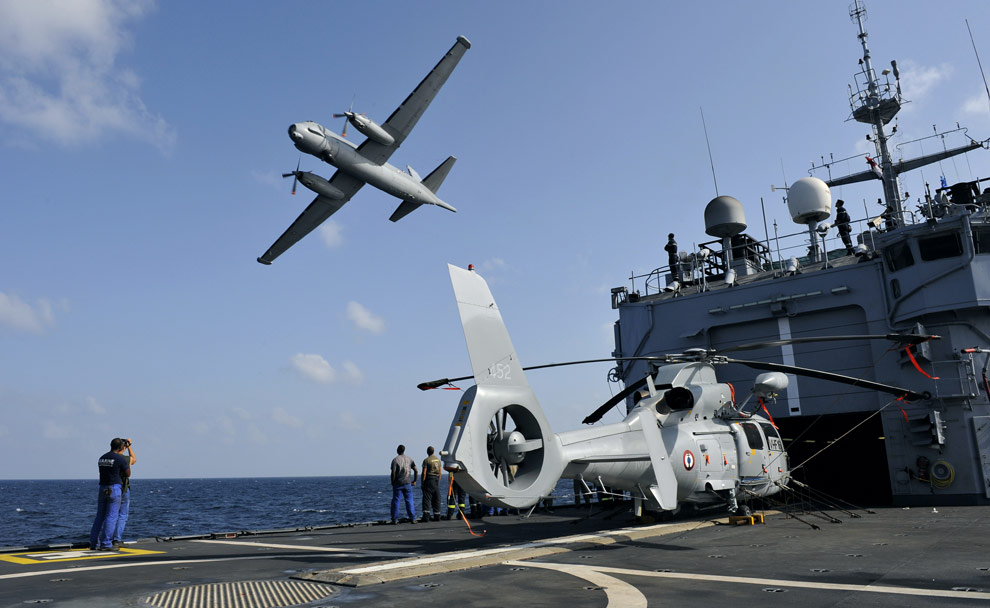
A French Atlantic plane passes over the French Frigate Le Floreal of the EPE (Embedded Protection Team), in the Gulf of Aden on January 10, 2009, as they escort a Danish ship with sensitive freight, off the coast of Djibouti, as part of an assignment to escort commercial ships in this area. (STEPHANE DE SAKUTIN/AFP/Getty Images) #
6
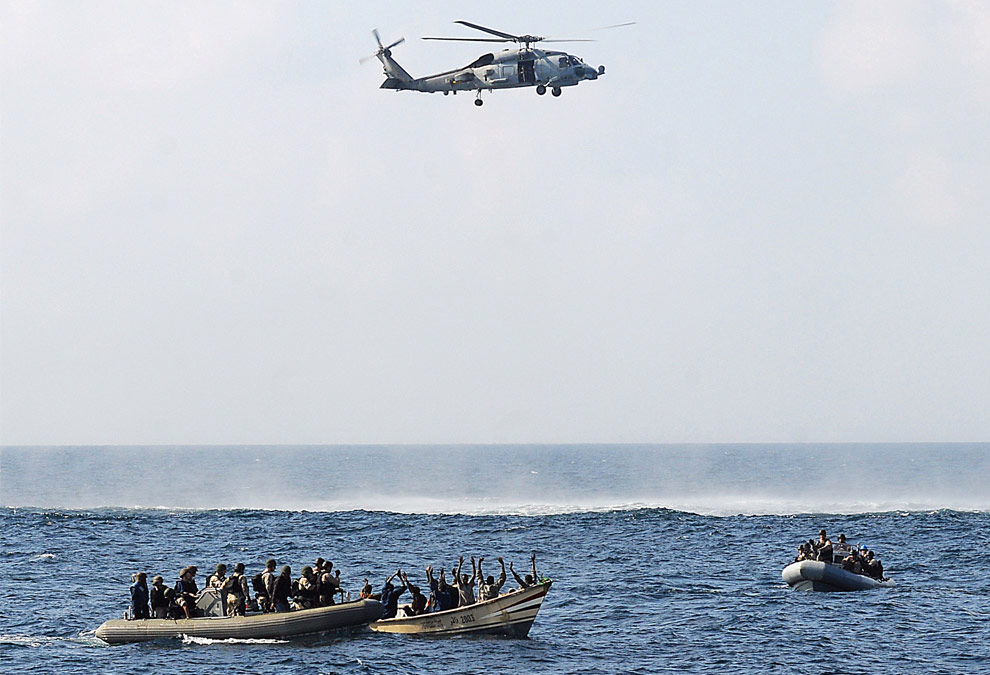
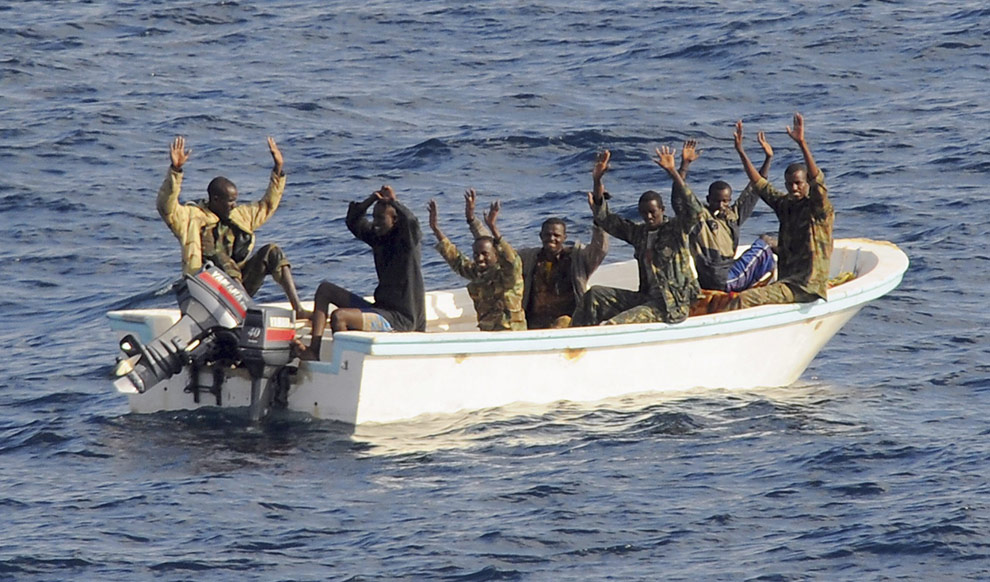
Suspected pirates keep their hands in the air as directed by sailors aboard the guided-missile cruiser USS Vella Gulf (CG 72) (not shown), in the Gulf of Aden, February 11, 2009. A multinational naval force seized the seven suspected pirates in the first such action in its anti-piracy campaign, the U.S. Navy said. (REUTERS/Jason R. Zalasky/U.S. Navy/Handout) #
7
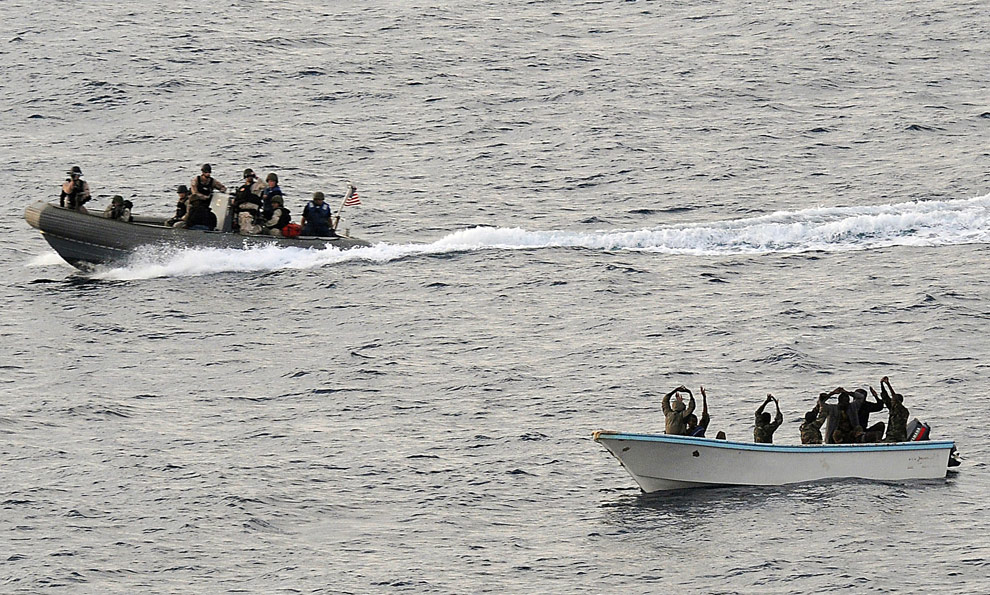
Search and seizure team members from the guided-missile cruiser USS Vella Gulf close in to apprehend suspected pirates in the Gulf of Aden February 11, 2009. The Vella Gulf is the flagship for Combined Task Force 151, a multi-national task force conducting counterpiracy operations to detect and deter piracy in and around the Gulf of Aden, Arabian Gulf, Indian Ocean and Red Sea. (Jason R. Zalasky/AFP/Getty Images) #
8
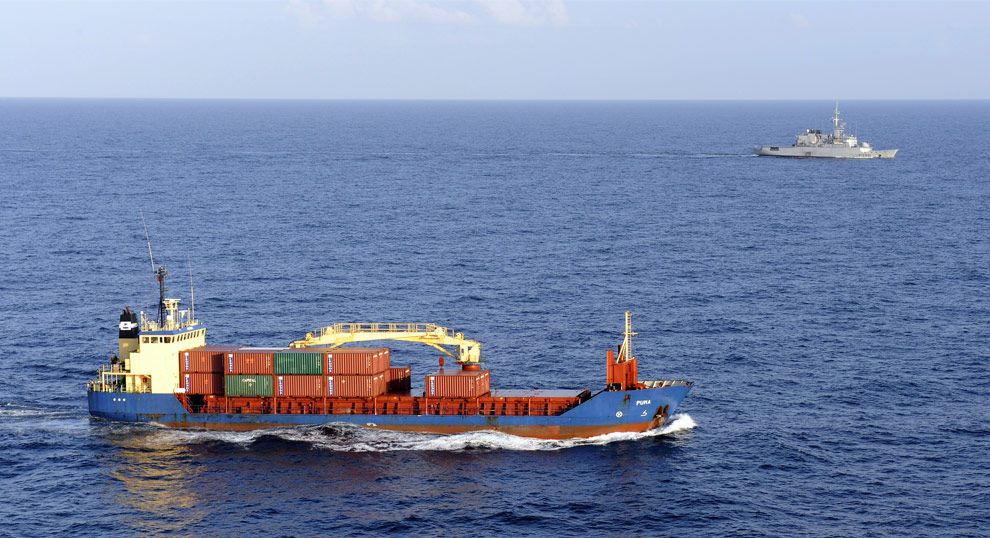
French frigate, Le Floreal watches over the Danish ship "Puma" which is carrying sensitive cargo, on January 11, 2009, in the Gulf of Aden. (STEPHANE DE SAKUTIN/AFP/Getty Images) #

9
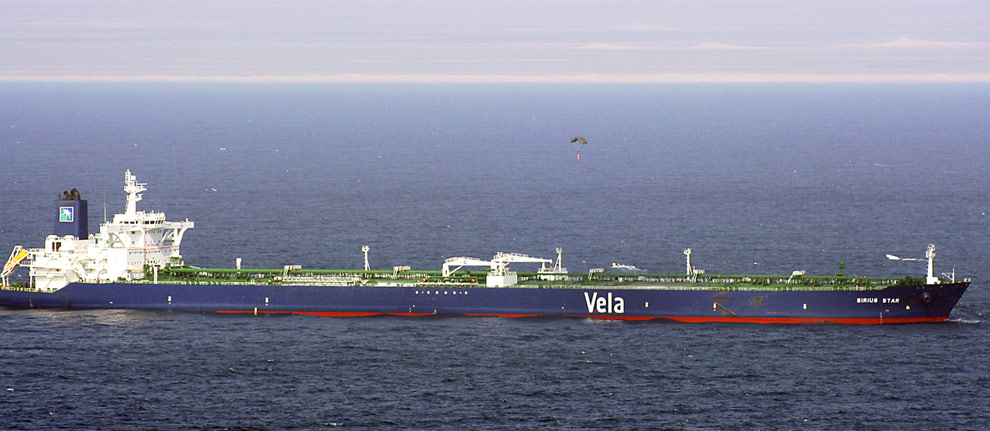
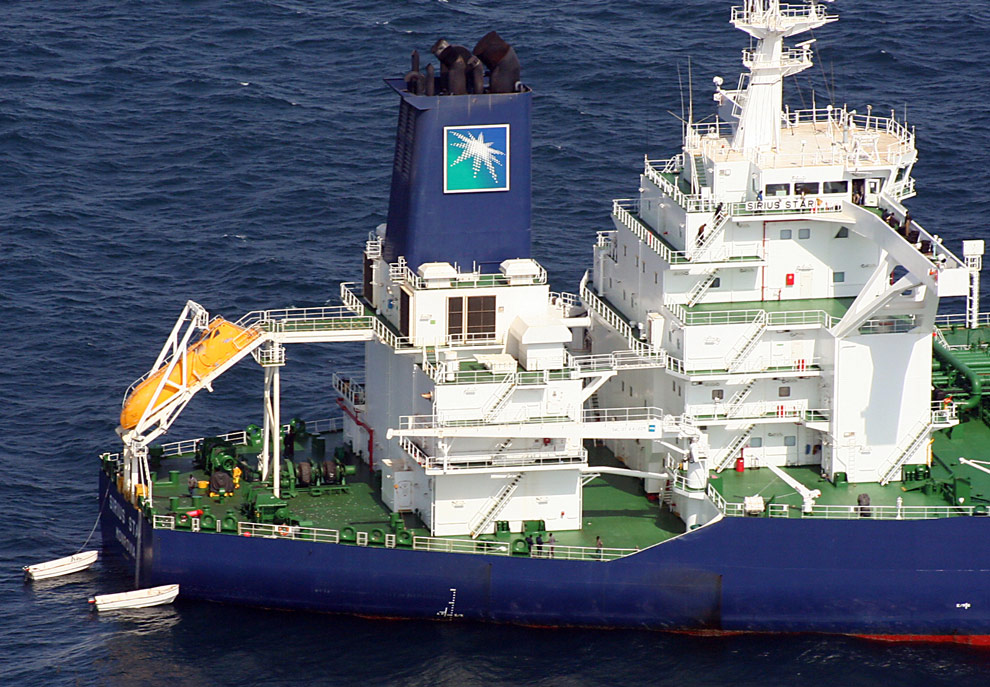
The MV Sirius Star is observed at anchor by the US Navy on January 9, 2009 following an apparent payment via a parachuted container to pirates holding the Sirius Star. Suspected pirates can be seen on deck an up in the command center. (David B. Hudson/AFP/Getty Images) #

A parachute dropped by a small aircraft is observed by the U.S. Navy as it drops over the MV Sirius Star during an apparent payment via a parachuted container to pirates holding the Sirius Star off the coast of Somalia, January 9, 2009. Somali pirates then freed the Saudi supertanker seized in the world's biggest ship hijacking for a $3 million ransom - but five drowned when their boat capsized as they were making off with their share. (REUTERS/David B. Hudson/U.S. Navy photo/Handout) #

Flying on board a Panther helicopter dispatched from the French frigate, Le Floreal, a crew member watches a commercial ship during a supervision mission on January 11, 2009, in the Gulf of Aden. (STEPHANE DE SAKUTIN/AFP/Getty Images) #

Search and seizure team members from the guided-missile cruiser USS Vella Gulf close in to apprehend suspected pirates in the Gulf of Aden February 12, 2009. (Jason R. Zalasky/AFP/Getty Images) #
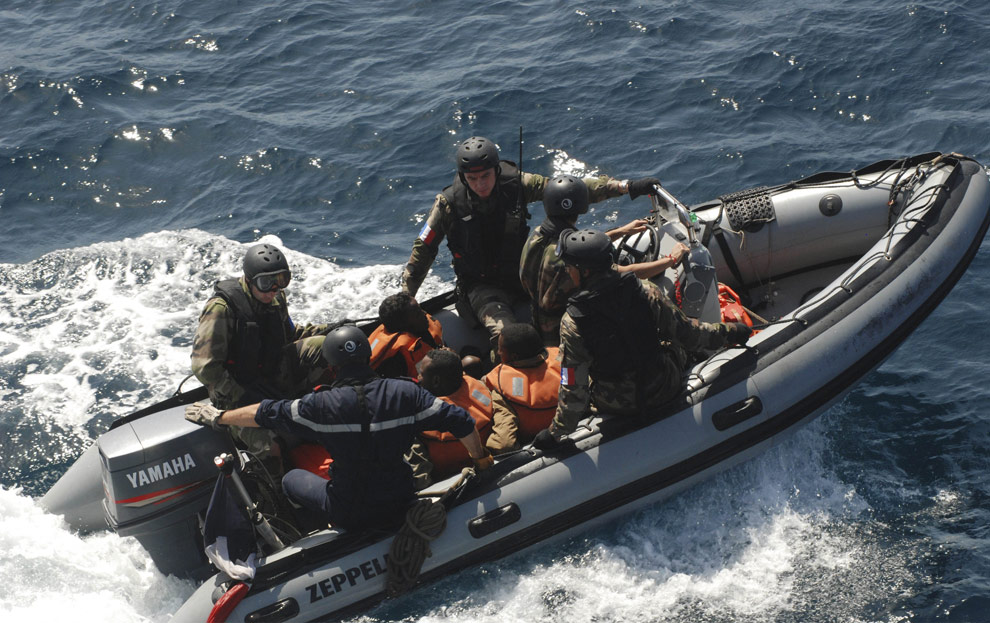
Commandos from French frigate Le Floreal arrest nine Somali pirates in the Gulf of Aden in this January 27, 2009 photo released on Wednesday by the French Navy. As foreign navies fight increasingly brazen gangs that hijack commercial vessels in busy shipping lanes. France has captured 57 pirates in seven such operations since last April. (HO/Reuters) #
This photo taken Sunday, Jan. 4, 2009 and provided by French Defense Ministry shows suspected pirates, intercepted by Marine commandos of the French Navy in the Gulf of Aden, off Somalia coasts. French government officials say the Jean de Vienne intercepted and captured 19 pirates Sunday as they tried to take over two cargo ships, one Croatian and the other Panamanian. (AP Photo/French Navy/French Defense Ministry/HO) #
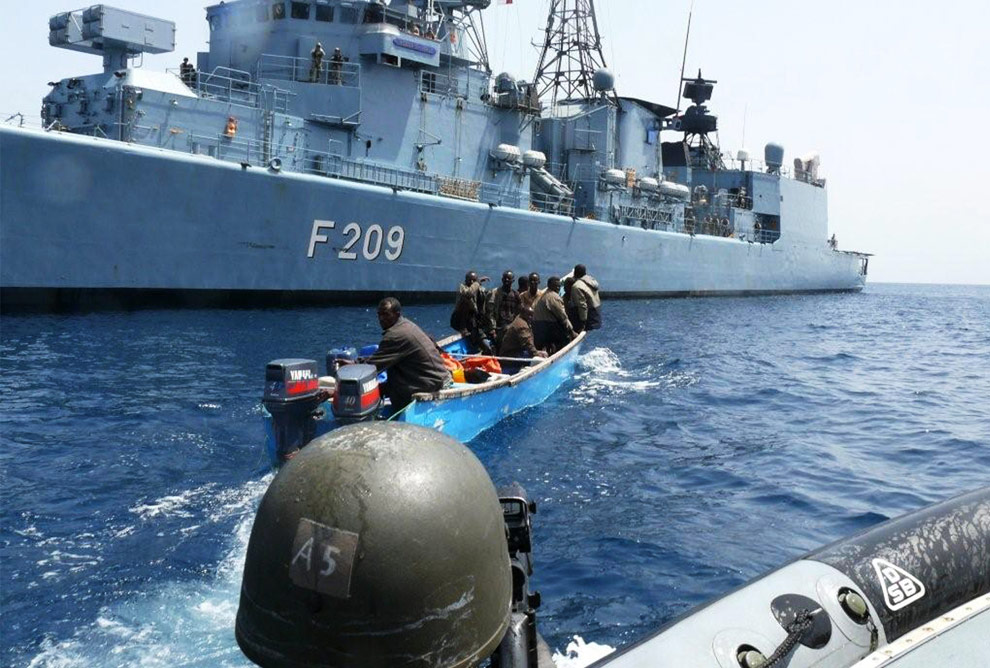
Picture released by the German Bundeswehr on March 4, 2009 shows Bundeswehr soldiers approaching pirates in the Gulf of Aden off Somalia on March 3, 2009, after frigate Rheinland-Pfalz (background) had received a distress call from a German-owned container ship saying she was under fire from pirates armed with bazookas and machine guns. The frigate then dispatched a helicopter which together with another chopper from the US naval ship Monterey stopped the attempted attack by firing warning shots. German soldiers boarded the pirate vessel and took the nine into custody, the German military said. (BUNDESWEHR/AFP/Getty Images) #
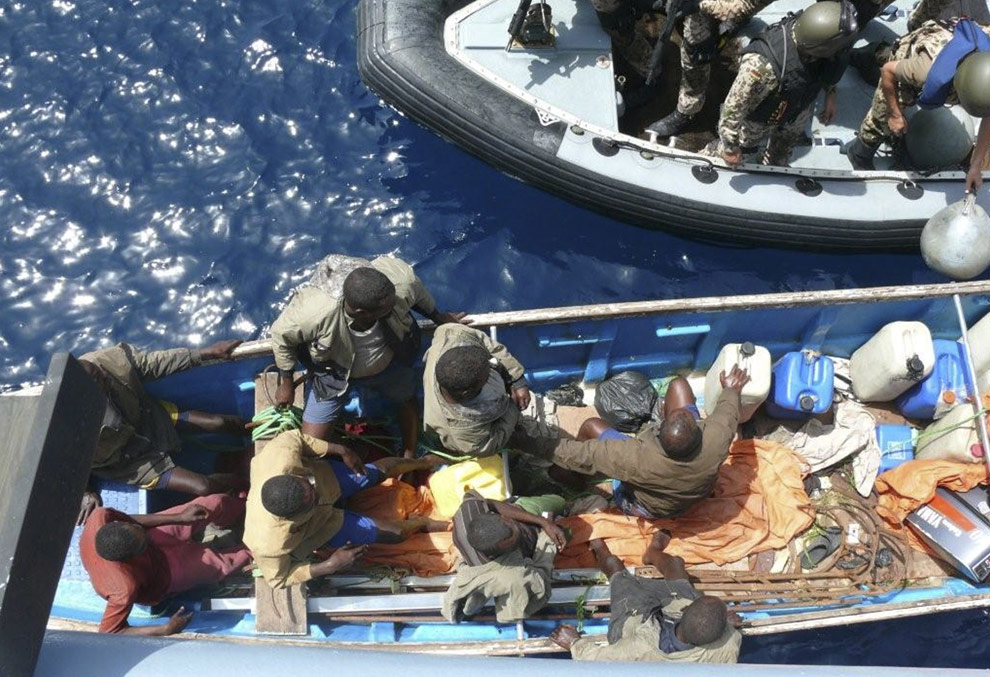
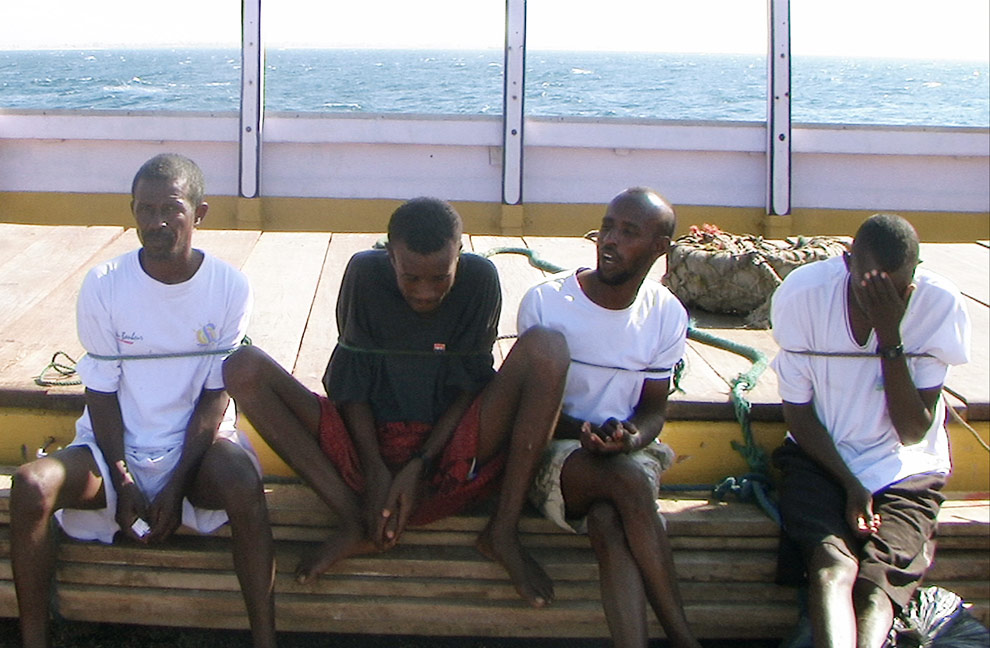
German navy from frigate Rheinland-Pfalz detain pirates in the Gulf of Aden off Somalia's coast on March 3, 2009, in this picture made available on March 4, 2009. (REUTERS/Bundeswehr) #

A Somali pirate captured in the Gulf of Aden is handed over by the French forces to the Puntland marine officials in the northern port town of Bosasso, Somalia on January 29, 2009. The French navy handed over nine suspected pirates to the authorities in Puntland. (REUTERS/Abdiqani Hassan) #

Suspected Somali pirates are seen after they were captured by Marine commandos of the French Navy in the Gulf of Aden, off Somalia's coast Thursday Jan. 29, 2009. (AP Photo) #

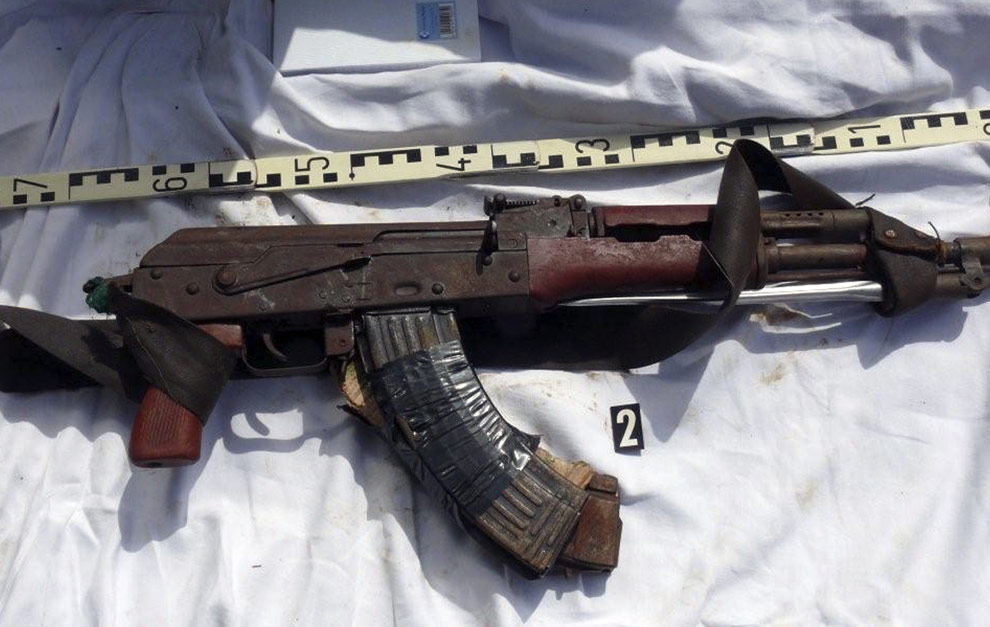
A rusty Kalashnikov assault rifle, confiscated from pirates detained by German navy from frigate Rheinland-Pfalz in the Gulf of Aden off Somalia's coast on March 3, 2009, in this picture made available on March 4, 2009. The German navy detained nine people on March 3, 2009 after they tried to attack a German merchant ship, German media reported. (REUTERS/Bundeswehr) #
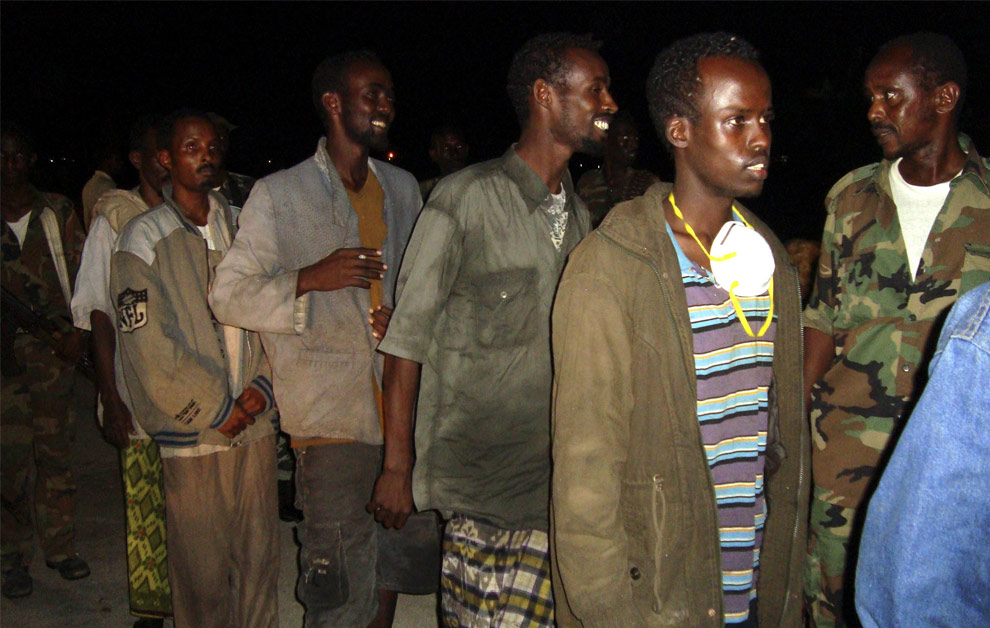
Somali pirates captured in the Gulf of Aden are presented to the Puntland marine forces in the northern port town of Bosasso, Somalia on March 2, 2009. U.S. forces handed over nine pirates to Somali authorities of the semi-autonomous region of Puntland on Monday, said local official. (REUTERS/Stringer) #
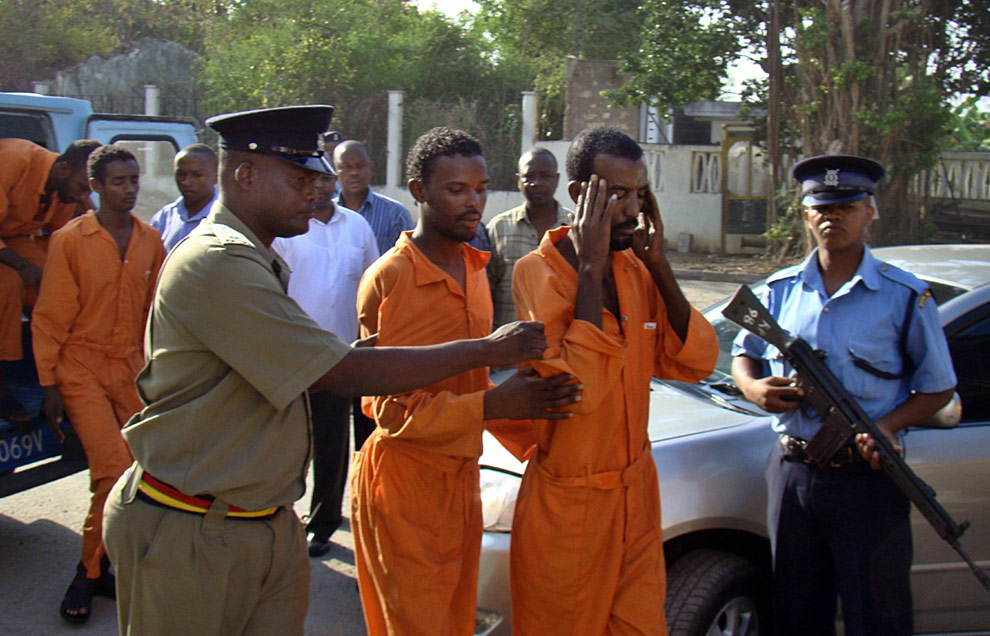
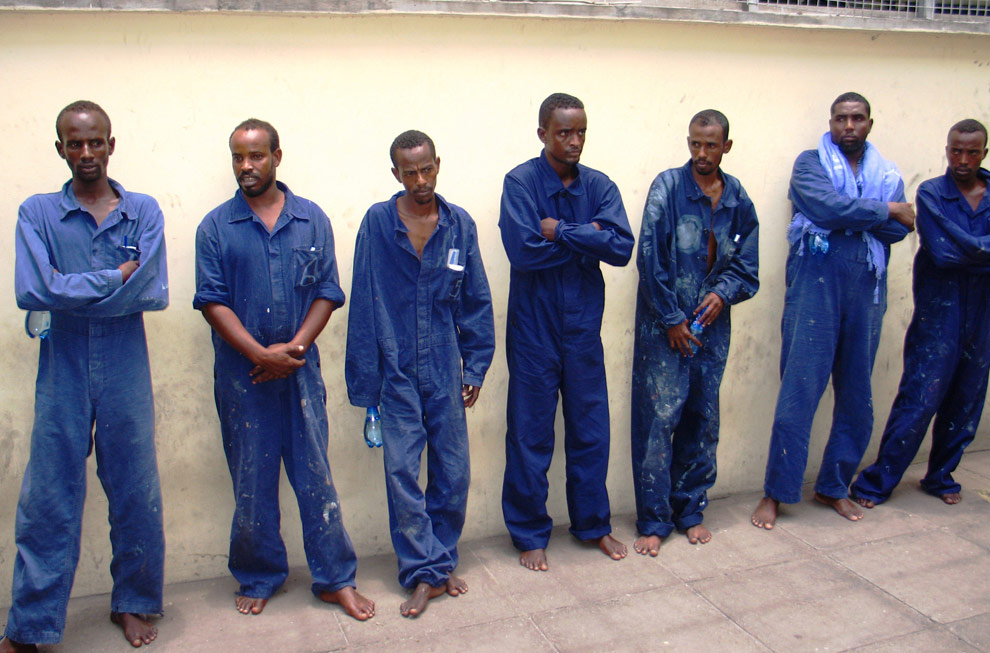
Seven Somalian pirates are led to court by Kenyan police officers on March 6, 2009 at the port town of Mombasa, Kenya. US Naval vessel VSS Leyte Gulf intercepted last month the pirates off the Somalian coast as they attempted to board a merchant vessel. (STRINGER/AFP/Getty Images) #

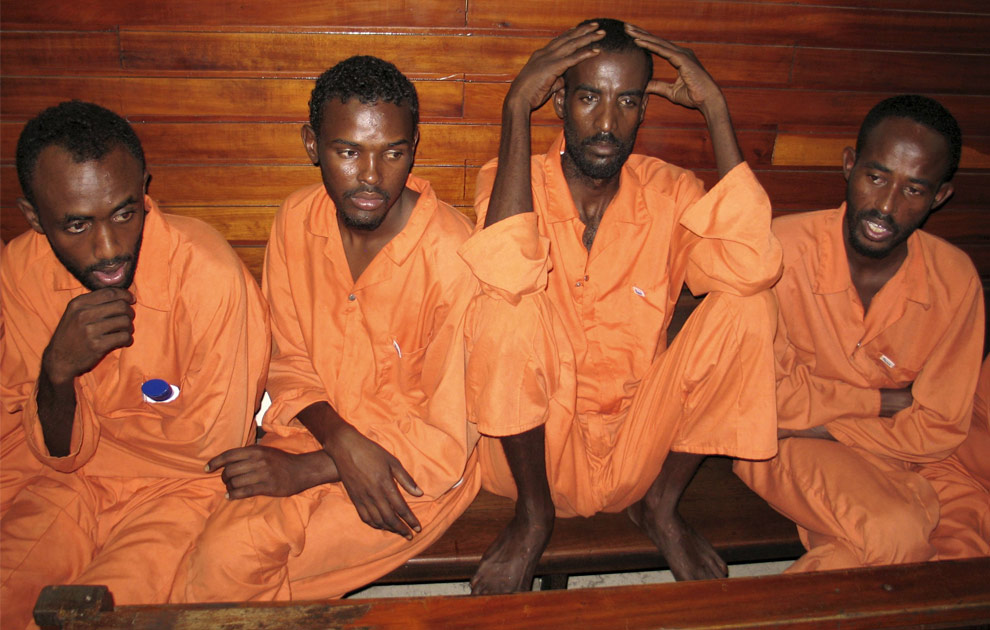
Some of the eight suspected Somali pirates at the Mombasa Law courts, Mombasa, Kenya, Wednesday, Jan 14, 2009, when the hearing of their piracy case started. The pirates were arrested early last month by naval officers from a British Naval Ship MV Knight Wave which has been on patrol along the Indian Ocean waters. Two British Naval officers were the first to give their evidence against the pirates. The hearing of the case will continue for three days.(AP Photo) #
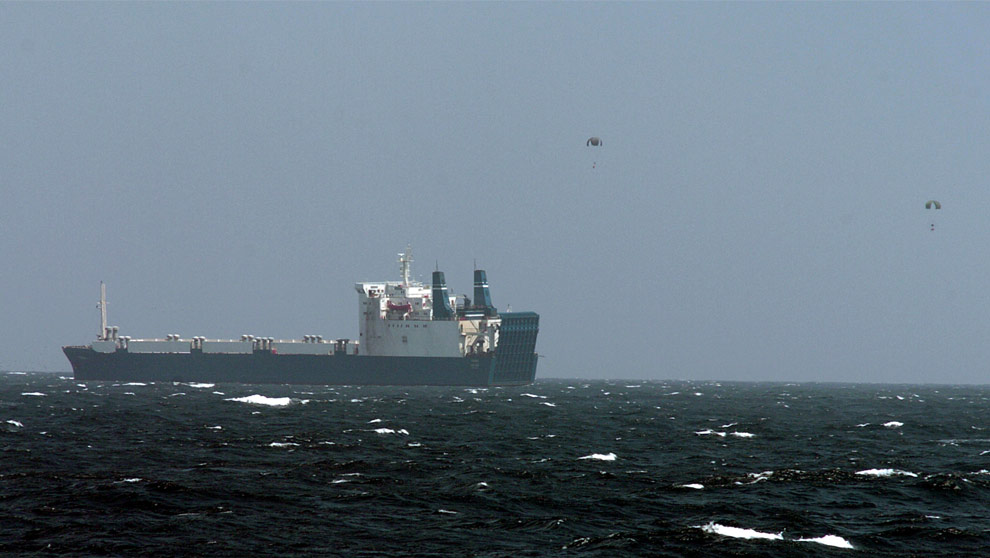
In this photo provided by the U.S. Navy, ransom money is dropped near the Ukrainian cargo ship MV Faina while under observation by a U.S. Navy ship February 4, 2009 off the coast of Somalia near Hobyo. Pirates did not leave the ship until February 5. (Michael R. McCormick/U.S. Navy via Getty Images) #
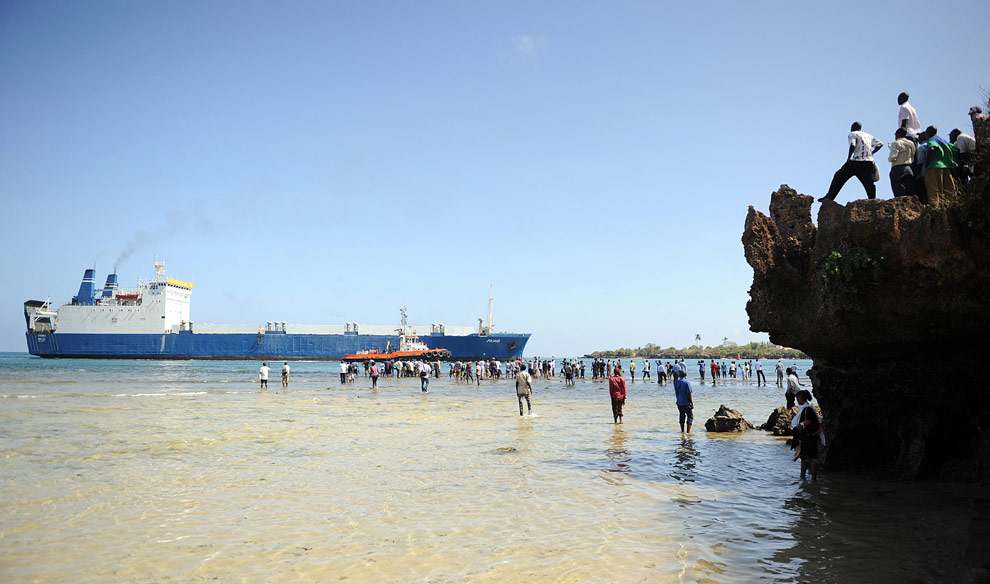
The Belize flagged MV Faina is escorted by a Kenyan port authority tug vessel into the port of Mombasa, Kenya on February 12, 2009, after it was released by Somali pirates a week ago. It arrived in Mombasa amid a raging controversy over its cargo of battle tanks and ammunition. While Kenya has always said the shipment was for its armed forces, several experts and diplomats in the region have revealed it was in fact destined to the government of South Sudan and was the fifth delivery of its kind in less than two years. (TONY KARUMBA/AFP/Getty Images) #
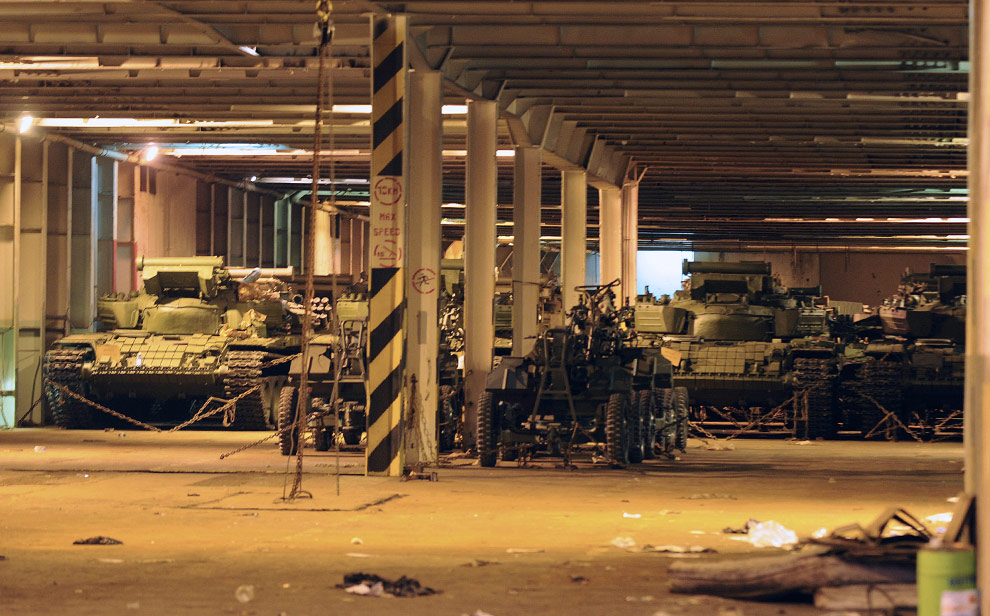
Soviet made T-72 tanks sit in the hull of the Belize flagged MV Faina on February 13, 2009 at the Mombasa, Kenya harbor where it has been berthed for the last two days. (TONY KARUMBA/AFP/Getty Images) #

Suspected pirates wait to be moved at the port in Mombassa, Kenya, Tuesday, March 10, 2009, after they were handed over to Kenyan police by the German navy who arrested them off the coast of Somalia the previous week. The frequency of attacks has actually increased since last year: 31 reported were reported in January and February compared to 111 for the whole of 2008, but the pirates are finding it harder to seize vessels. (AP Photo) #
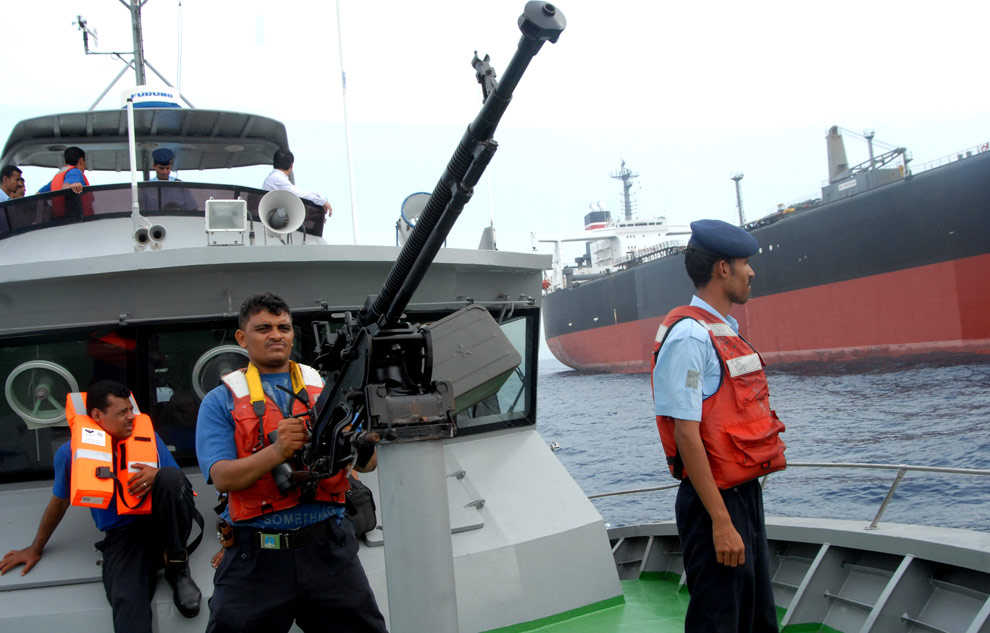
File picture dated April 22, 2008 shows Yemeni coast guards on standby next to the damaged Japanese tanker Takayama, that was attacked by pirates following its arrival in the southern Yemeni port of Aden. Half of the its members don't know how to swim and they don't have enough boats, leaving Yemen's coast guards struggling to meet the enormous maritime challenges facing one of the world's poorest nations; piracy. (KHALED FAZAA/AFP/Getty Images) #
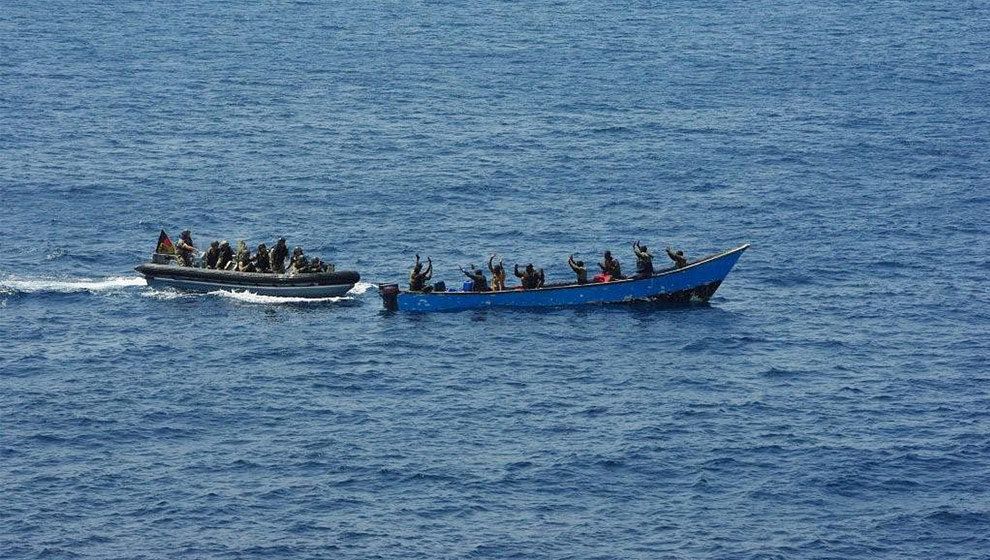
German Bundeswehr soldiers approach pirates in the Gulf of Aden off Somalia on March 3, 2009, after the German frigate Rheinland-Pfalz had received a distress call from a German-owned container ship saying she was under fire from pirates armed with bazookas and machine guns. (BUNDESWEHR/AFP/Getty Images) #
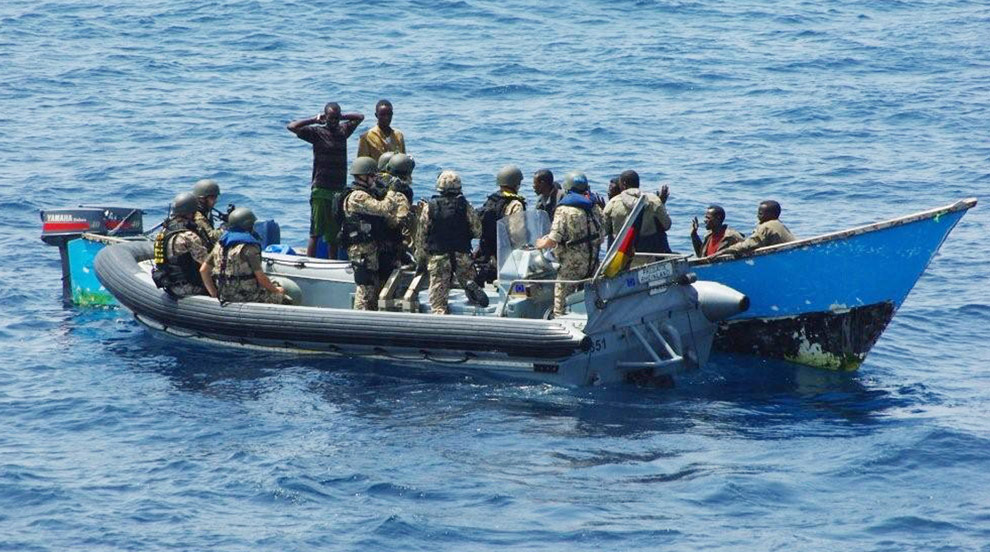
German Bundeswehr soldiers apprehend pirates in the Gulf of Aden off Somalia on March 3, 2009. (BUNDESWEHR/AFP/Getty Images) #

Suspected Somali pirates sit in the dock inside a court of law in the Kenyan coastal town of Mombasa March 6, 2009. The United States had turned over seven suspected Somali pirates to Kenya for prosecution for the first time under a bilateral pact that opened the way for the U.S. Navy to capture pirates on the high seas. (REUTERS/Joseph Okanga) #

February 7, 2012

Tsukiji Fish Market

Asia • 16.02.2012

Tsukiji Fish Market


Tsukiji Fish Market - one of the biggest wholesale fish and seafood market, although here you can find any other product. Then buy goods as wholesalers and fish restaurants in the Japanese capital and ordinary buyers. The market is located in central Tokyo and is one of the main attractions for foreign tourists. On the day here sold about 2,888 tons of goods (more than 450 species of fish and seafood) in excess of 2.8 billion yen.

2089 800x533 Tsukiji Fish Market


1709 Tsukiji Fish Market
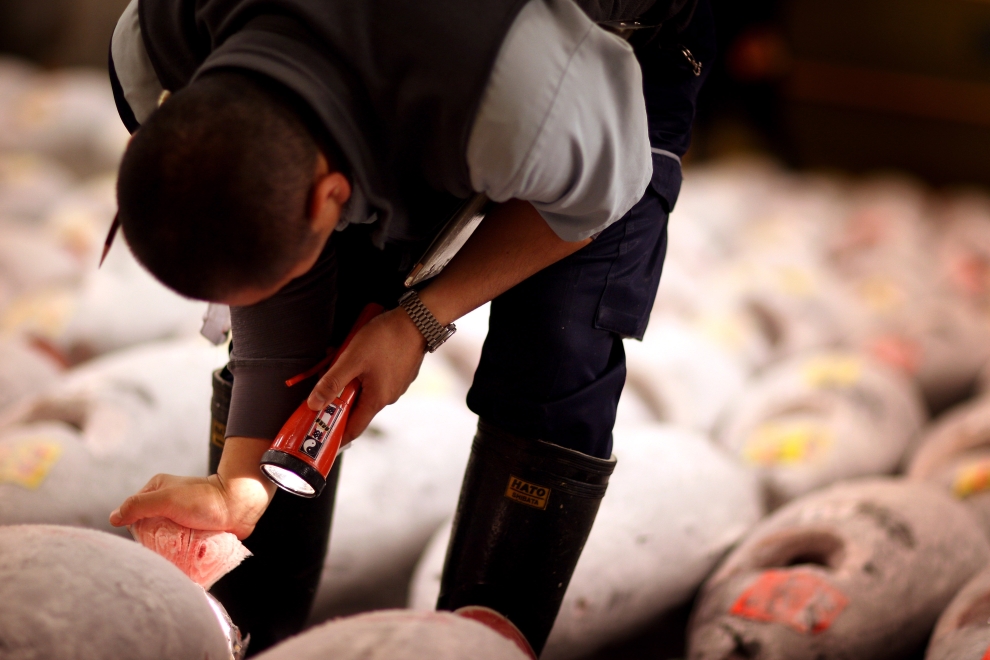
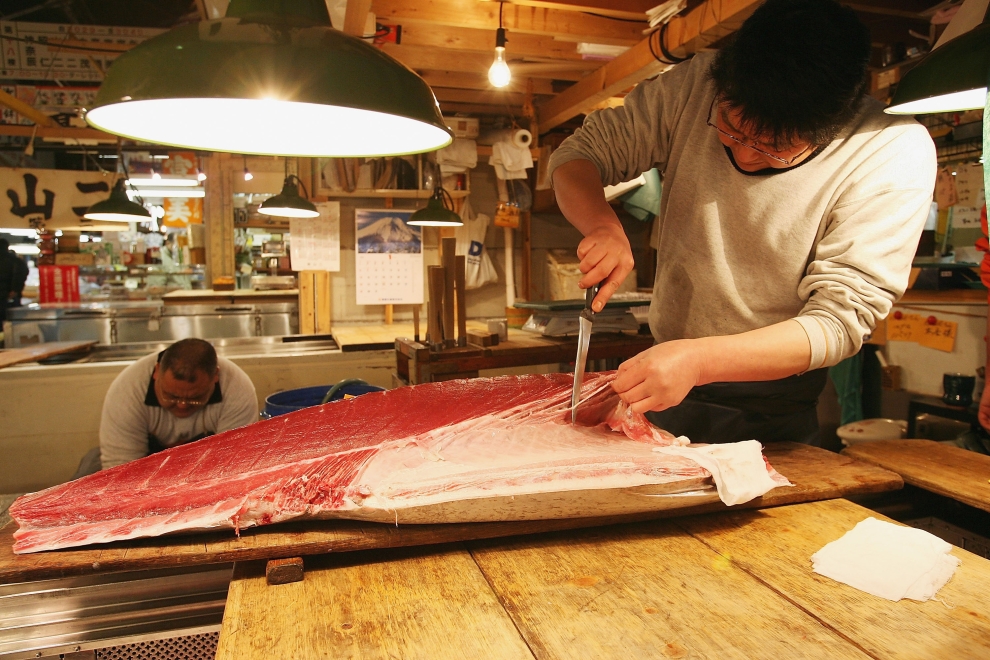
1 worker checks the quality of the fish for sale. (Photo: Chris Jackson / Getty Images)
Tokyo urban wholesale market, better known as Tsukiji Fish Market is located next to the station and the Tsukiji subway Tsukidzisidzё Tokyo.
2385 Tsukiji Fish Market
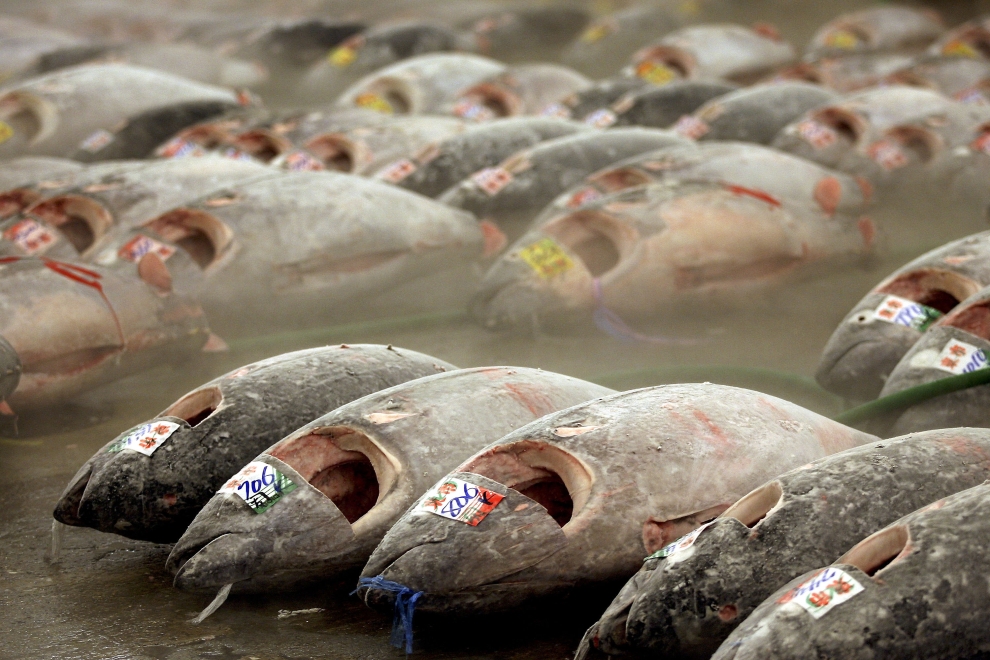
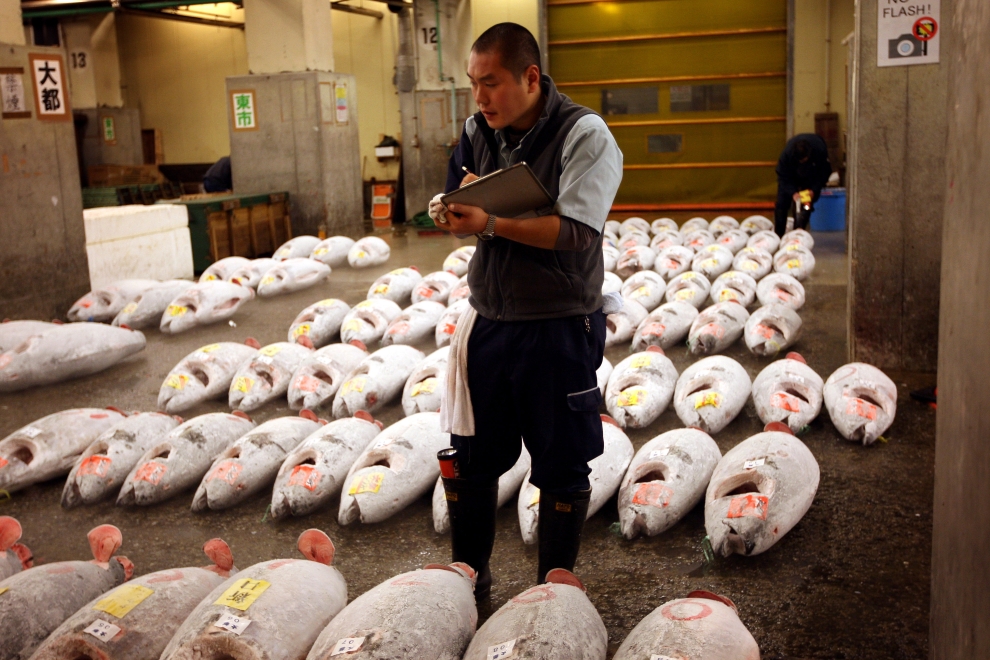
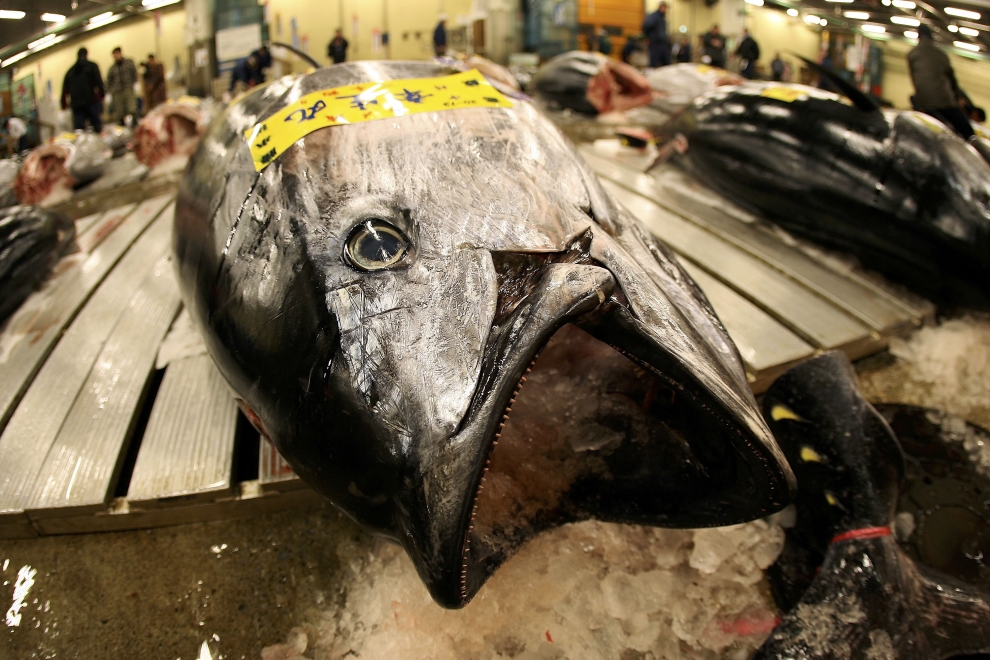
2 frozen tuna in anticipation of buyers during the auction before the New Year. (Photo: Koichi Kamoshida / Getty Images)
The market consists of two separate sections. The so-called "internal market" (Jap. 場内 市場 jo: nai Shijo :?) is a licensed wholesale market, where trades are conducted and fish processing takes place, and where the trays are about 900 licensed vendors. On the "outer market" (Jap. 場外 市場 jo: gai Shijo :?) can be found both wholesale and retail shops that sell Japanese kitchen utensils ready restaurant products, food products, and seafood.
3269 Tsukiji Fish Market
3 The quality of fish products sold during the auction goes through several stages of verification. (Photo: Chris Jackson / Getty Images)
There is also a large number of restaurants, particularly specializing in the production of the land. Most of the shops in the foreign market closes before noon, and in the domestic even earlier.
4208 Tsukiji Fish Market
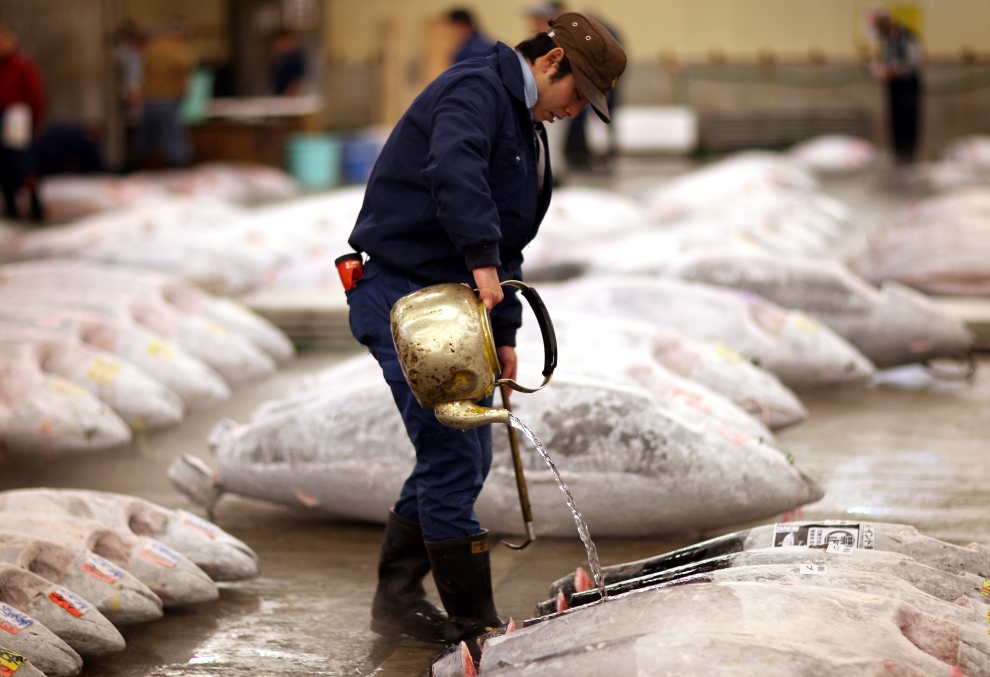
4 Frozen fish were thawed before the auction. (Photo: Chris Jackson / Getty Images)
In the market you can find more than 400 different types of seafood, from small sardines to 300-kilogram tuna, from cheap seaweed to expensive caviar.
5164 Tsukiji Fish Market
5 One of the wholesalers exports out of the store bought items at the auction. (Photo: Koichi Kamoshida / Getty Images)
About 700 thousand. Metric tons of seafood pass through the shelves of three fish markets in Tokyo, which in monetary terms is 600 billion yen (about 5.5 billion dollars). Directly through the Tsukiji fish market is held over 2 thousand. Metric tons of seafood per day.
6148 Tsukiji Fish Market
6 Wholesaler checks the quality of evisceration of carcasses of tuna. (Photo: Koichi Kamoshida / Getty Images)
The number of registered employees varies between 60 to 65 thousand. Persons, which include wholesalers, accountants, auctioneers, company representatives and distributors.
7144 Tsukiji Fish Market
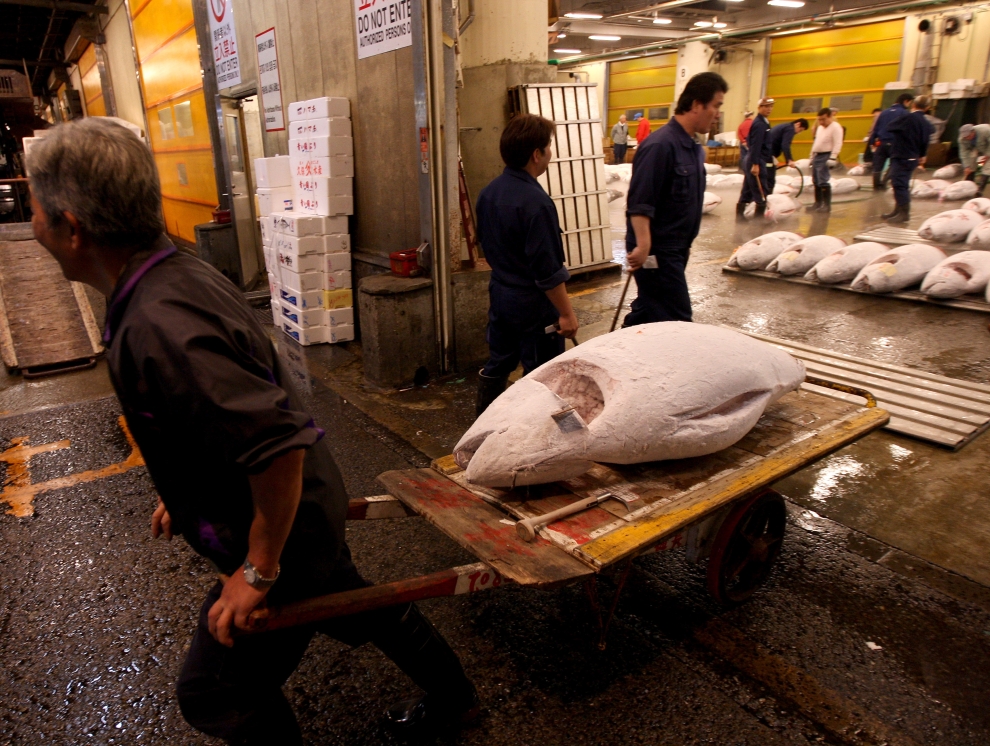
7 Employee market exports frozen carcass tuna stock. (Photo: Chris Jackson / Getty Images)
Tsukiji Market is open almost every morning, except Sundays, holidays and the rare days with a break at the reception of the goods, which begins at 3:00 in the morning. The most impressive thing is unloading frozen tuna.
8139 Tsukiji Fish Market
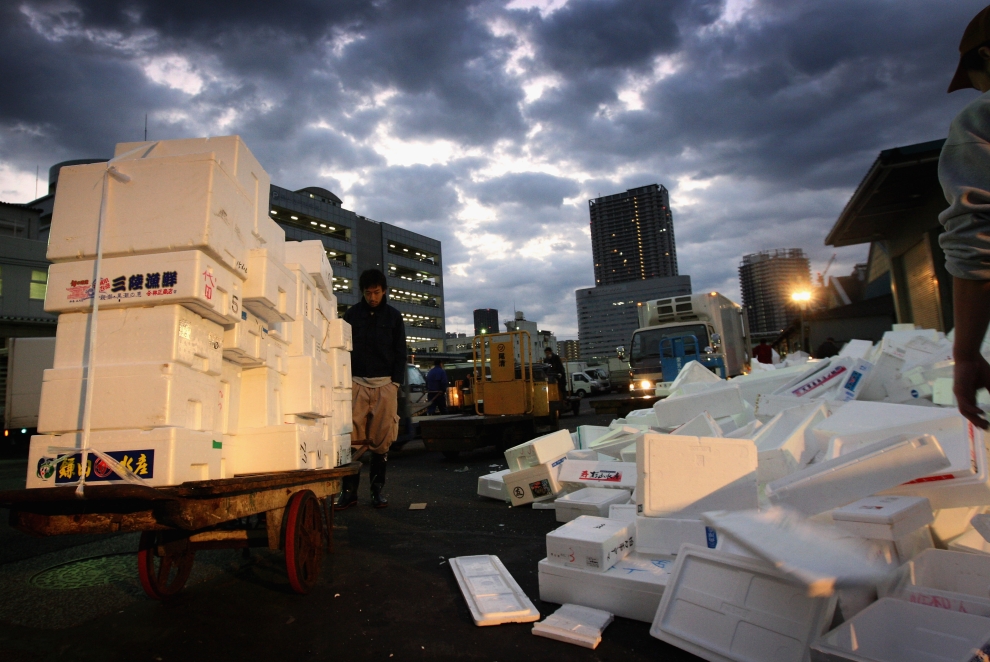
8 Worker market driven trolley with the packed seafood past piles of packaging material. (Photo: Chris Jackson / Getty Images)
After unloading, the auction houses (wholesalers in Japanese called 卸 売 業 者 orosiuri gyo: Smiling) assess the value and prepare the incoming items to the auction. Buyers (only those who have a license to participate) also evaluated the party fish in order to know for what they will fight to the highest bidder and what price are willing to pay.
9135 Tsukiji Fish Market
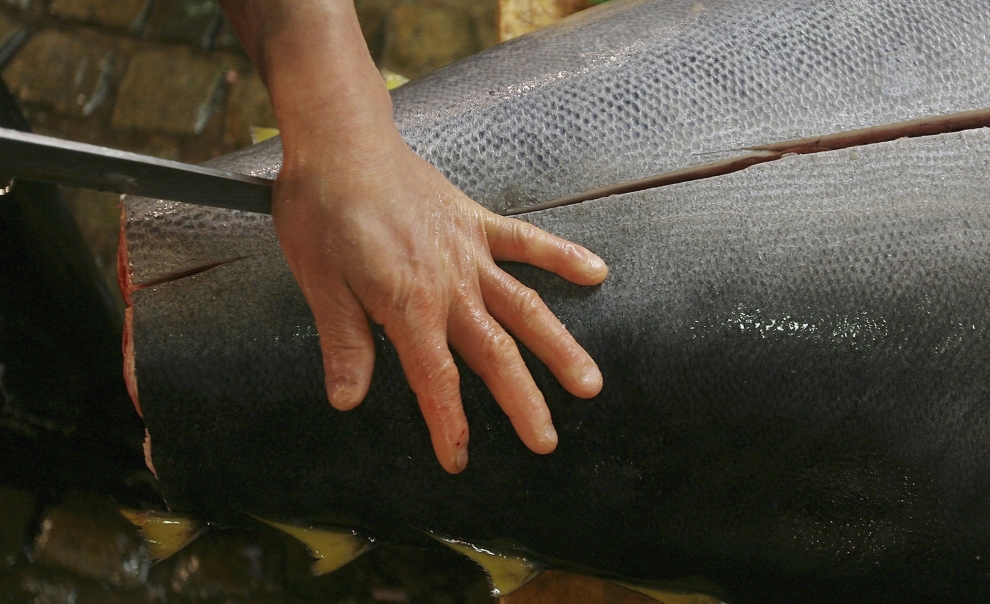
9 Employee market carcass cuts of tuna into smaller portions. (Photo: Koichi Kamoshida / Getty Images)
Bidding starts at around 5:00 in the morning. As the number of buyers could include mediation Wholesalers (仲 卸 業 者 nakaorosi gyo: Smiling), that is, those who sell goods in the same market, as well as buyers of commodities for restaurants, food companies, and large retailers.
10146 Tsukiji Fish Market
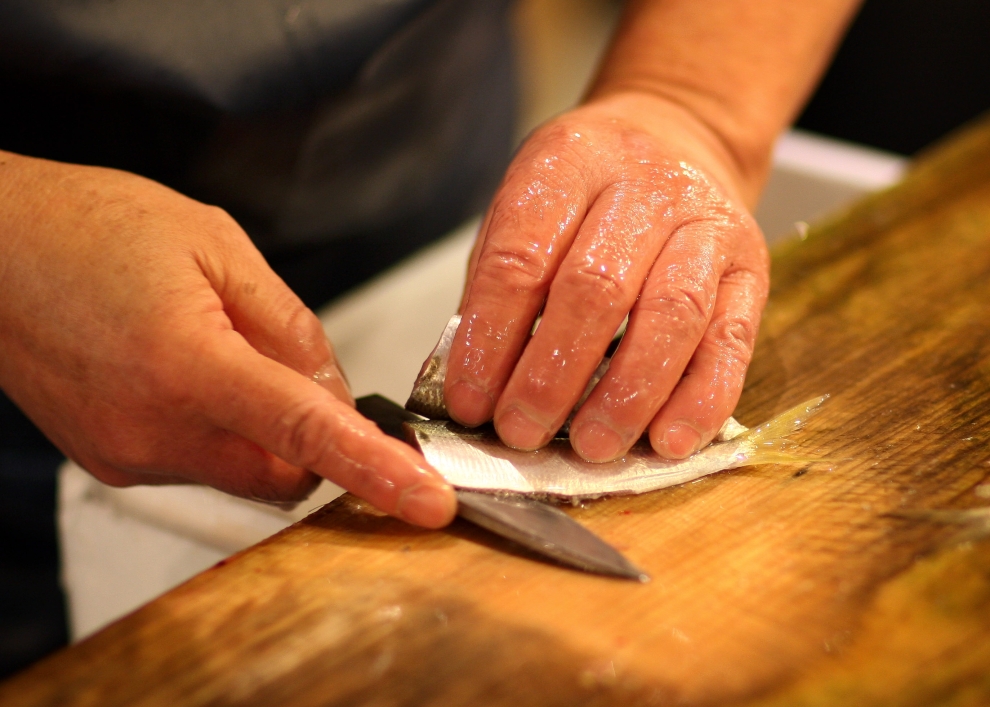
10 Cutting the fish carcasses. (Photo: Koichi Kamoshida / Getty Images)
Bidding usually end around 7:00 am. Then bought fish or loaded onto ships for delivery to the next item repetition, or on small carts transported to numerous shops inside the market. Their owners are prepared and cut up fish for subsequent retail sale.
11184 Tsukiji Fish Market
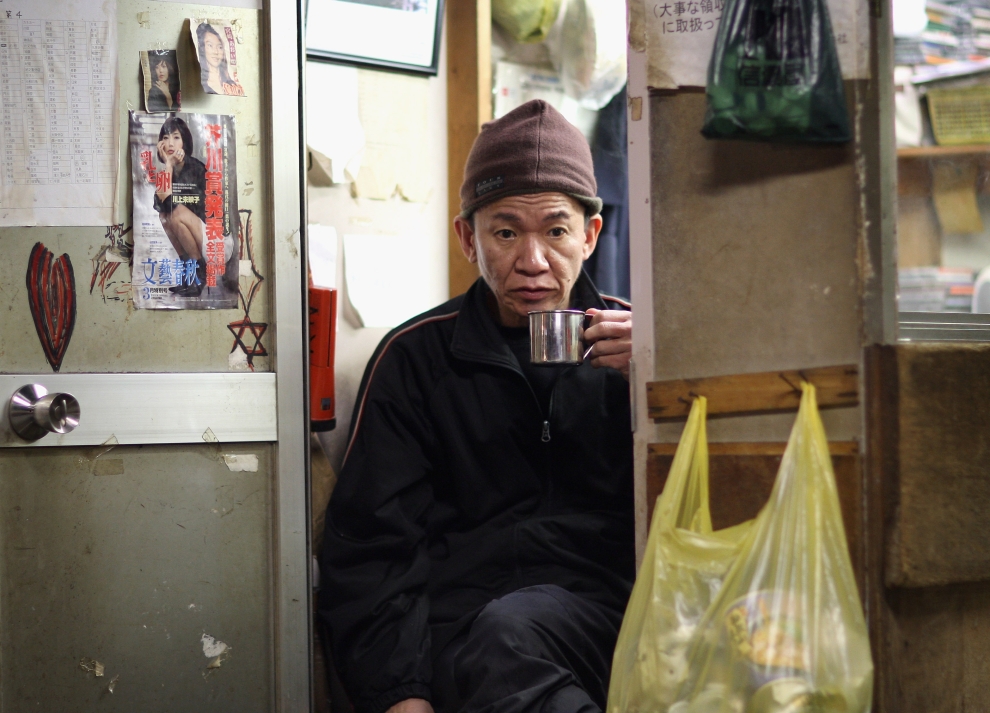
11 Adjournment of a cup of tea. (Photo: Chris Jackson / Getty Images)
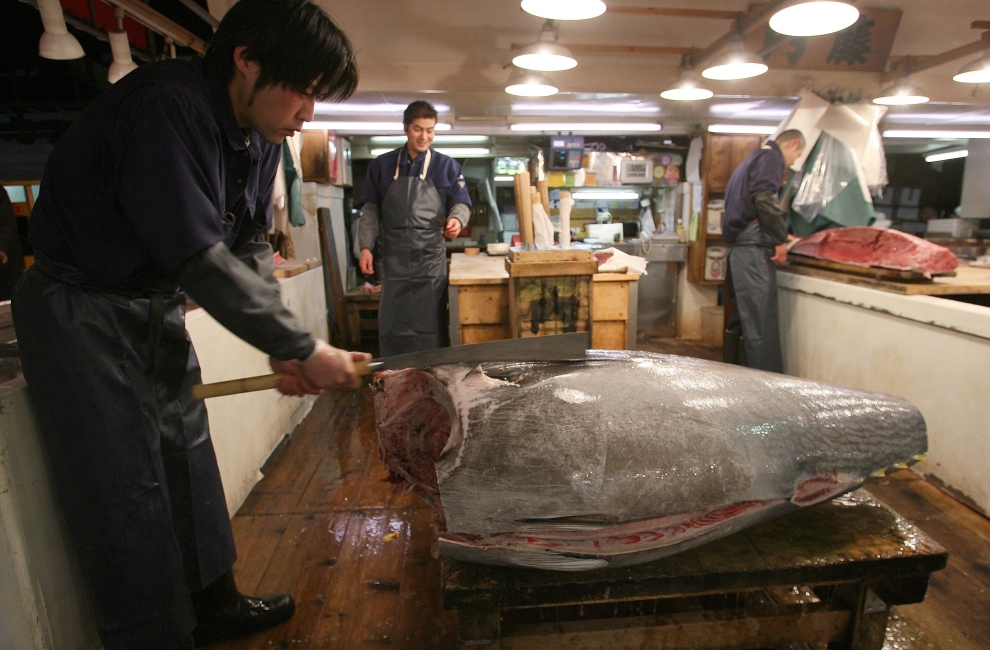
Razdelyvanie large fish such as tuna or swordfish comes with special care. For example, tuna is cut large bandsaw, and already cut parts - a very long knife (sometimes up to 1 meter in length), which is called Orosi hotё (Eng.) Hantё ​​hotё or maguro-botё.
12154 Tsukiji Fish Market
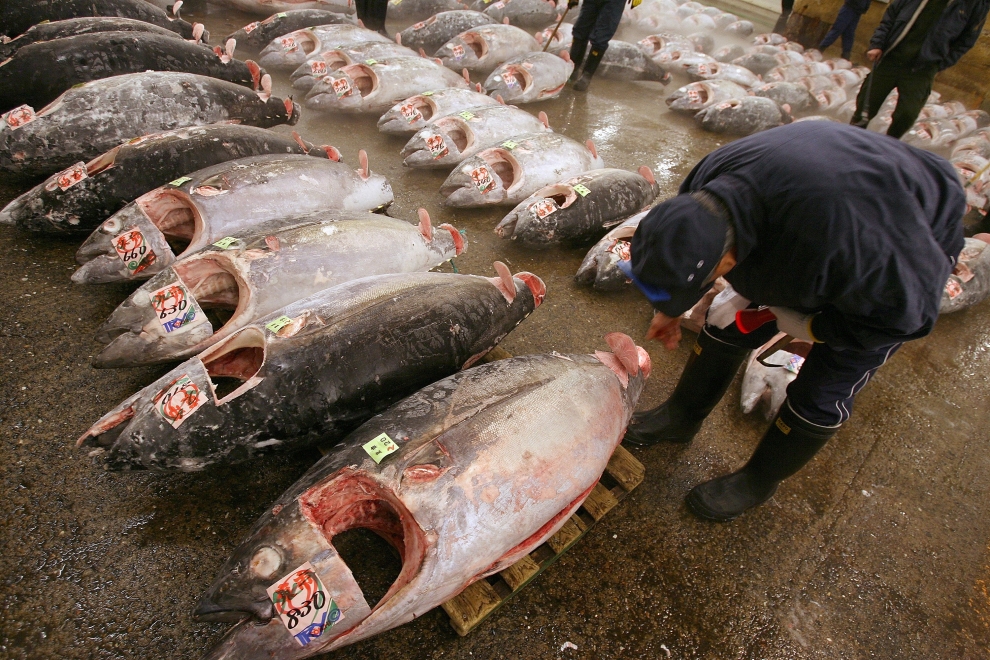
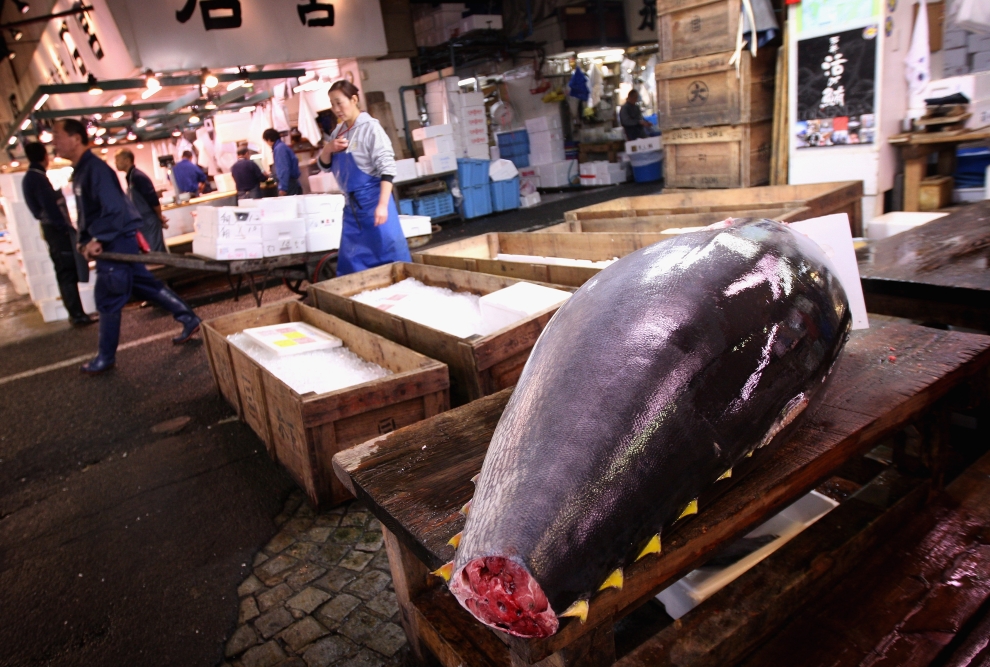
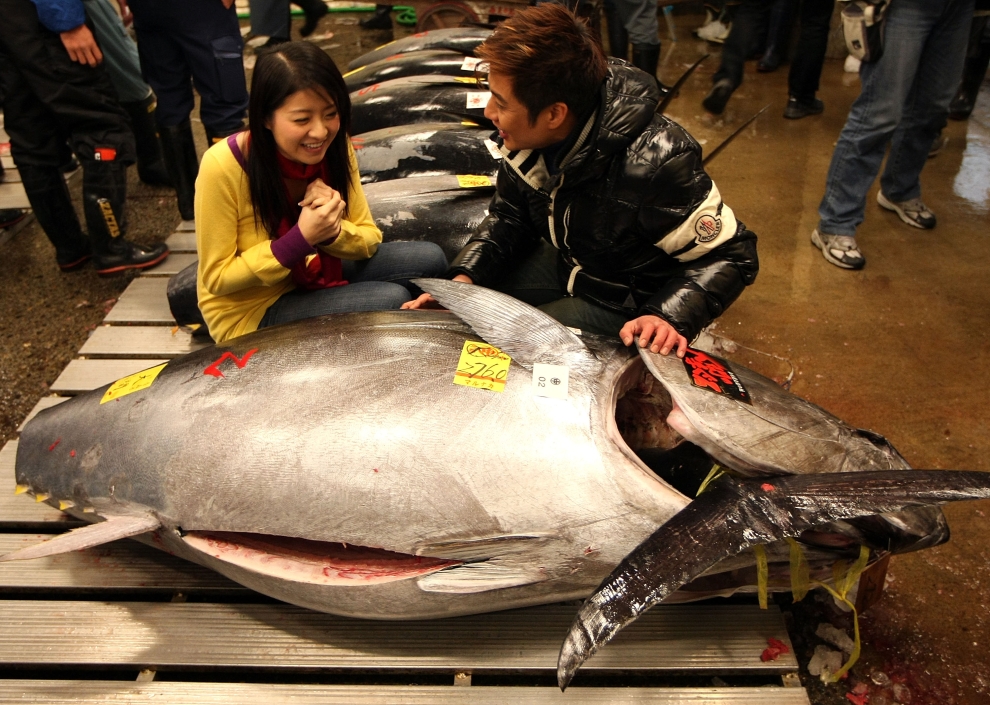
Carcass 12 yellowfin tuna, which will soon cut into smaller pieces. (Photo: Chris Jackson / Getty Images)
Most active in the market are usually from 5:00 am to 8:00 am, and then it declines sharply. Most shops and stores closed by 11:00 am, and the market of the day at 13:00. Tourists can visit the market every day from 5:00 to 6:15 in the morning and watch the work of the market and all transactions with a specially designated area.
13138 Tsukiji Fish Market
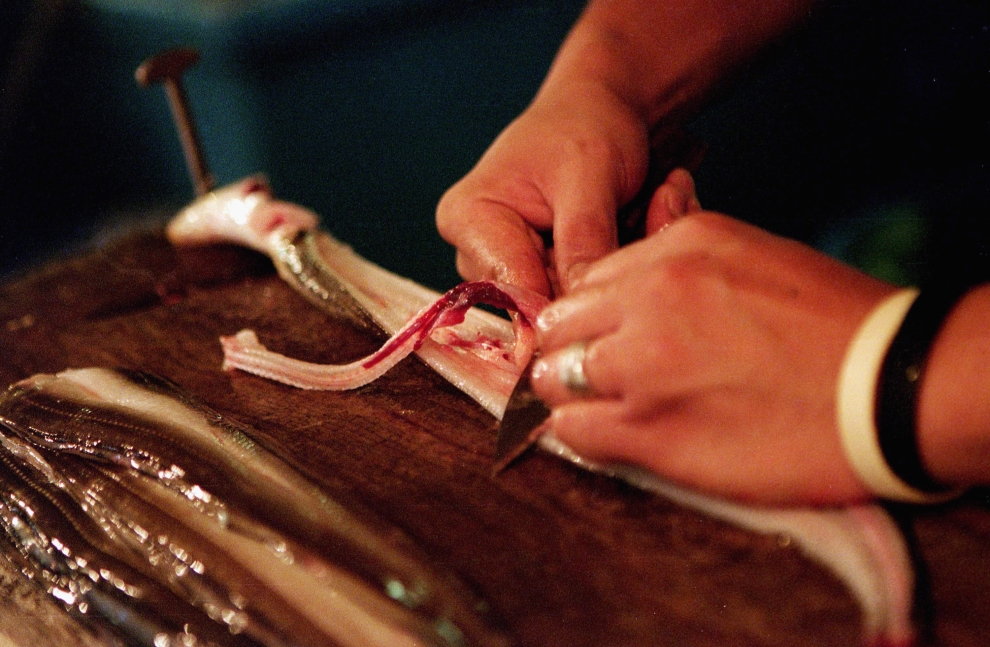
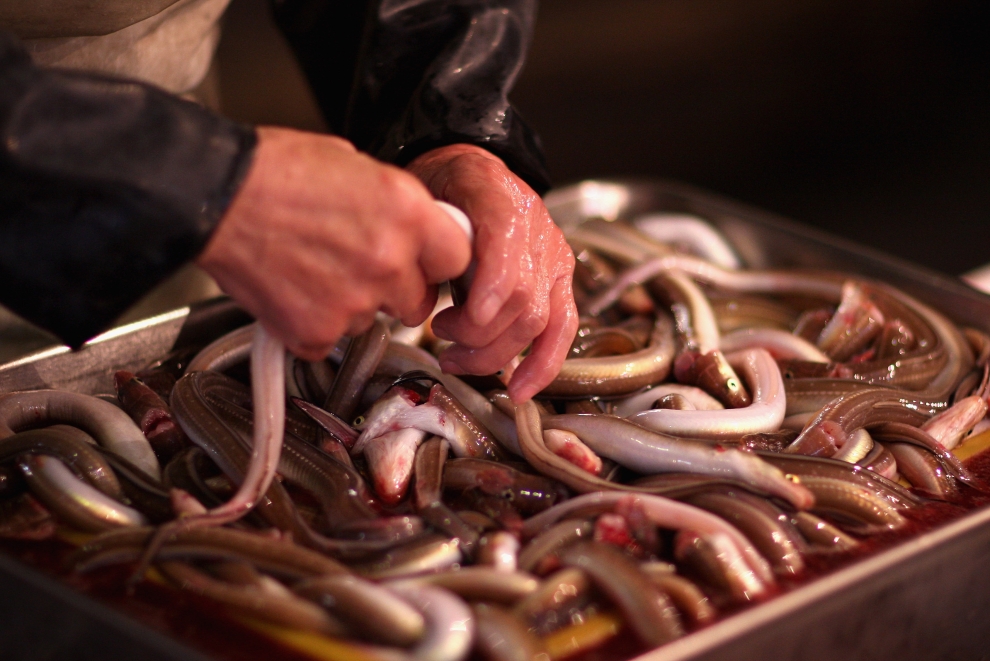
13 Fishmonger guts eel. (Photo: Cameron Spencer / Getty Images)
Compliance with the law of the purity of food should be inspectors from the Tokyo Metropolitan Government.
14129 Tsukiji Fish Market
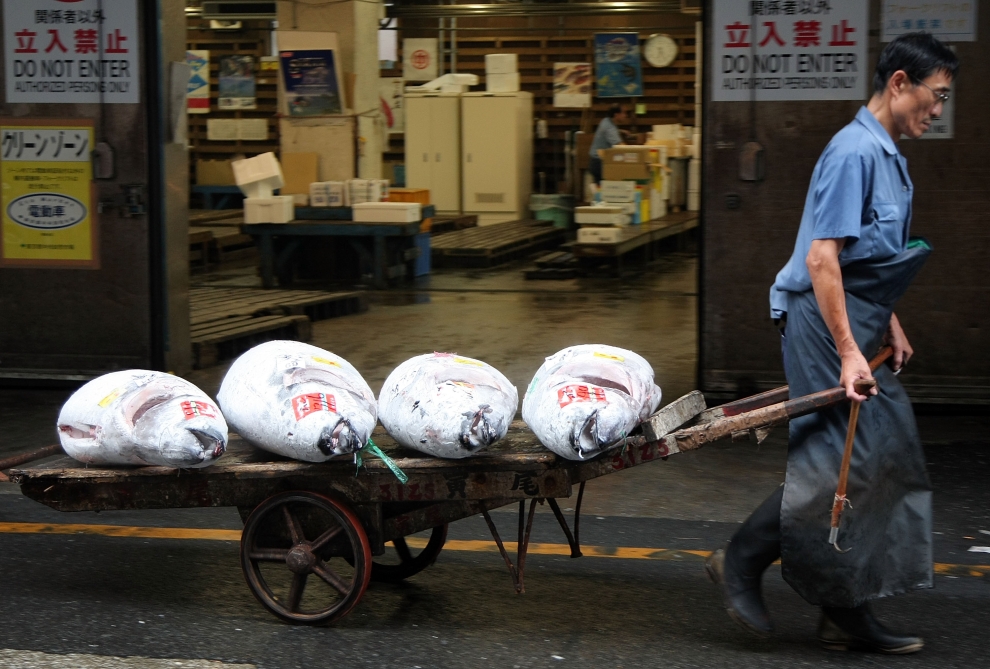
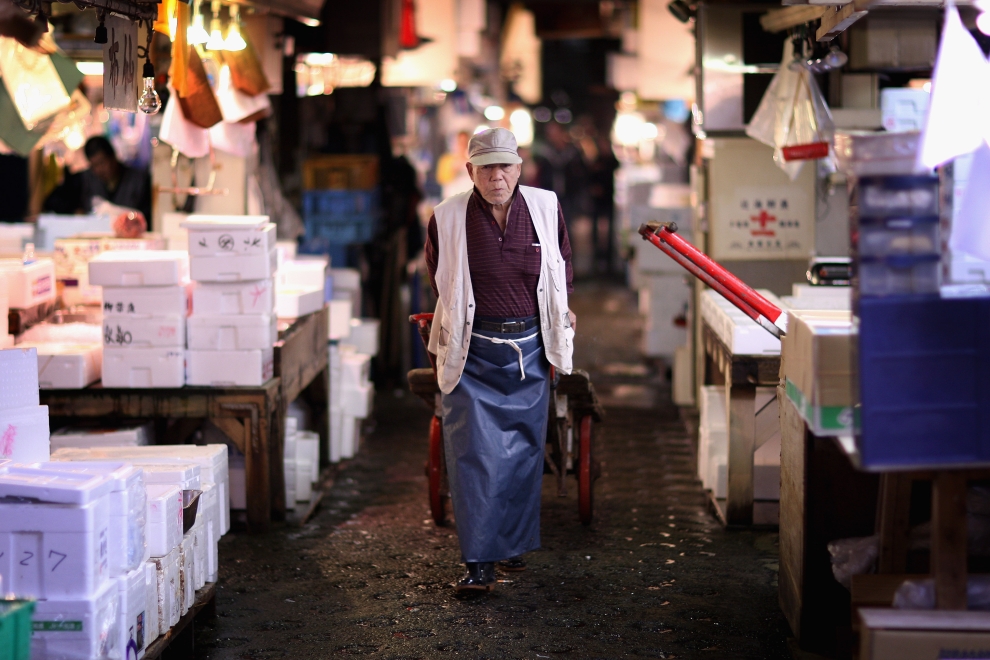
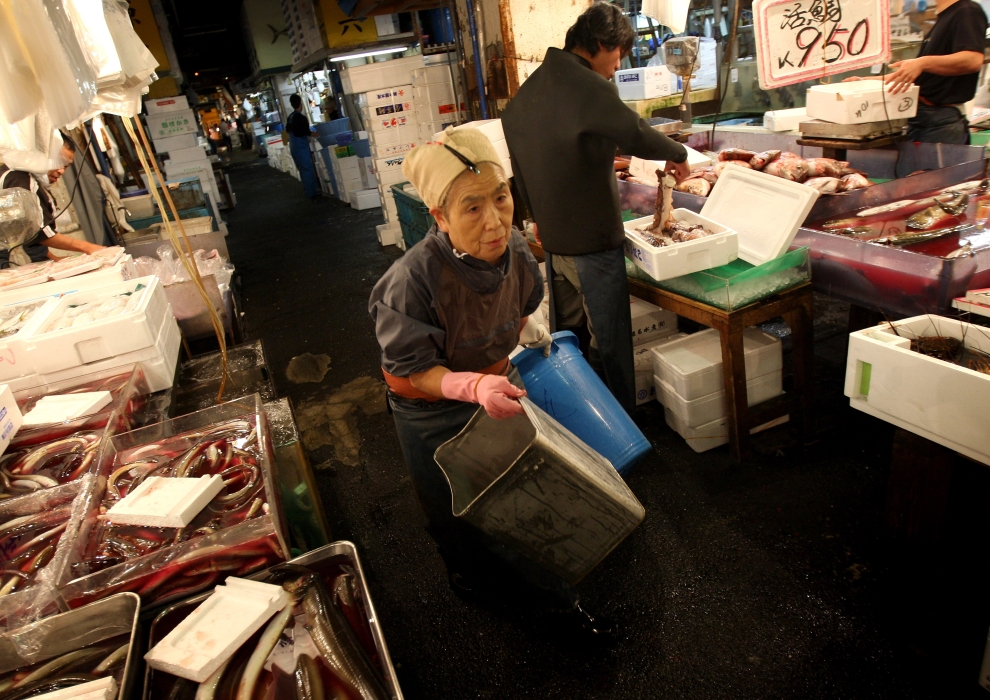
14 employee market pulls his cart through the narrow passages between the stalls. (Photo: Chris Jackson / Getty Images)
The first market in Tokyo was established Tokugawa Ieyasu during the Edo period for provisions fortress Edo (modern Tokyo), who invited for this purpose fishermen from Osaka. Fish, which remained excessive, sold near the bridge Nihonbashi (Eng.) Marketed under the name "uogasi» (魚 河岸, «Fishing Pier") - one of many of specialized markets, which was connected by channels with the Edo period (so called Tokyo to 1870h) .
15126 Tsukiji Fish Market
15 Cutting fresh tuna before an auction on the eve of the New Year. (Photo: Koichi Kamoshida / Getty Images)
16116 Tsukiji Fish Market
16 Cleaning the fish before selling. (Photo: Chris Jackson / Getty Images)
In August 1918, during the so-called rice riots, when more than a hundred cities and towns protested against the lack of food and the speculative activities of wholesalers, the Japanese parliament was forced to build new facilities for trade in food, especially affected the big cities.
17109 Tsukiji Fish Market
17 waste after cutting fish. (Photo: Chris Jackson / Getty Images)
18104 Tsukiji Fish Market
18 staff scurrying between market stalls. (Photo: Chris Jackson / Getty Images)
Central Wholesale Market was founded in March 1923. Great earthquake September 1, 1923 almost completely destroyed the central part of Tokyo with the market near Nihonbashi.
1990 Tsukiji Fish Market
19 gutted eels prepared for transport. (Photo: Chris Jackson / Getty Images)
2089 Tsukiji Fish Market
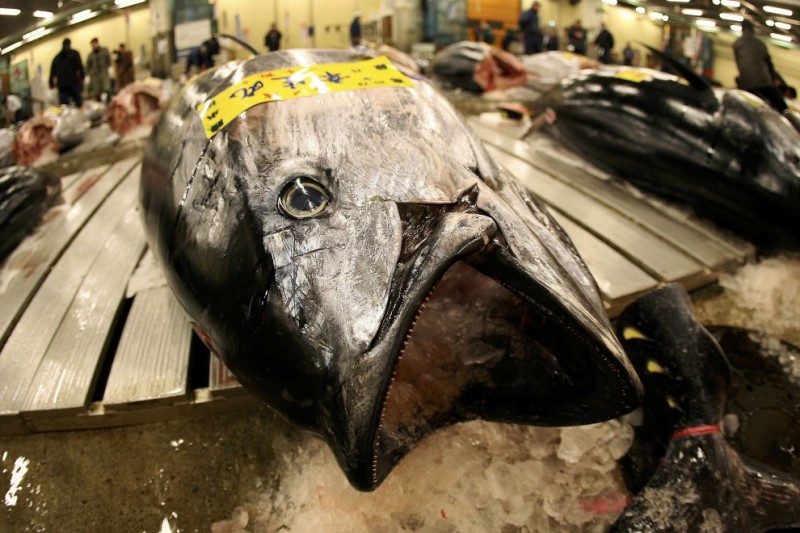
20 The whole tuna filled with ice. (Photo: Koichi Kamoshida / Getty Images)
Subsequently, the market was moved to Tsukiji district and at the end of the construction of modern infrastructure was completed in 1935 and started working at the Central Wholesale Market, together with markets in the areas of Coto and Kanda. Now Tokyo-based system of wholesale markets includes more than a dozen major markets and their affiliates that sell seafood, meat and so on. D.
21140 Tsukiji Fish Market
21 Reporters shoot story about the sale of the giant tuna to block the morning news. (Photo: Koichi Kamoshida / Getty Images)
22109 Tsukiji Fish Market
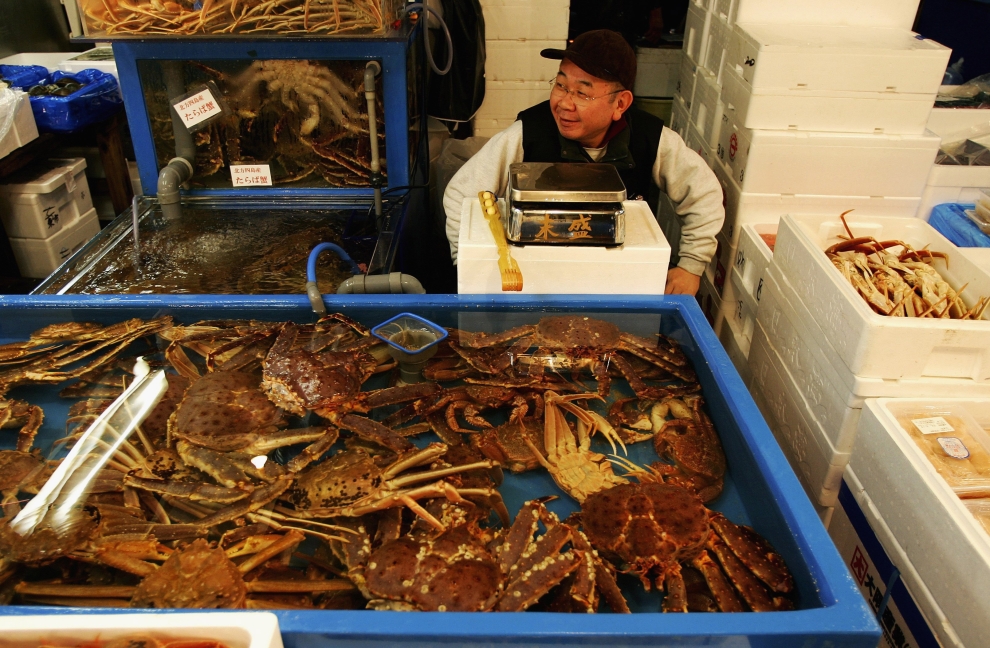
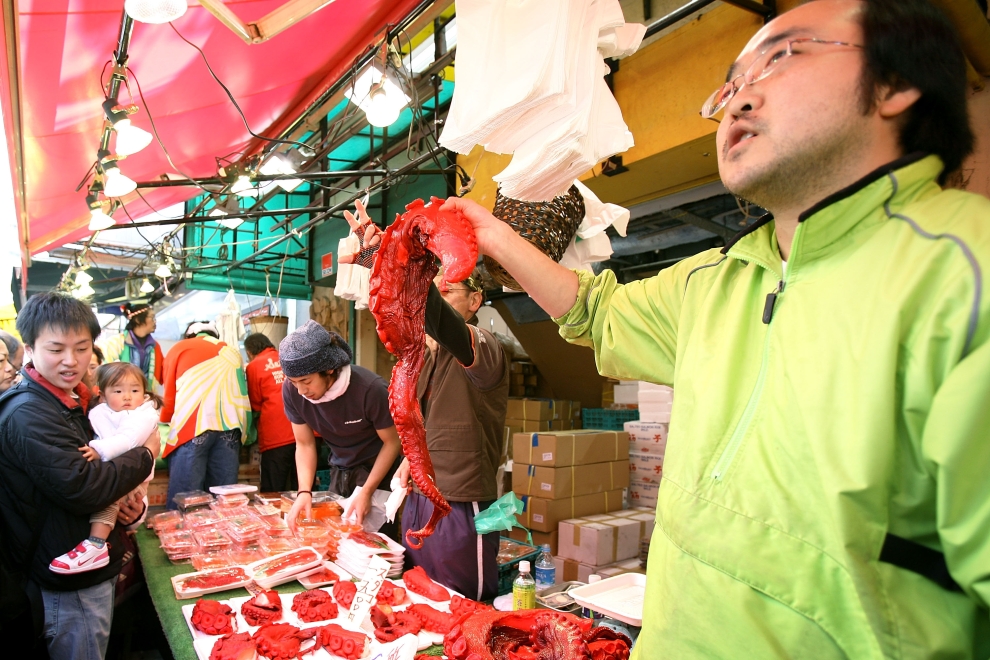
22 The seller waits for customers of containers with crabs. (Photo: Cameron Spencer / Getty Images)
2386 Tsukiji Fish Market
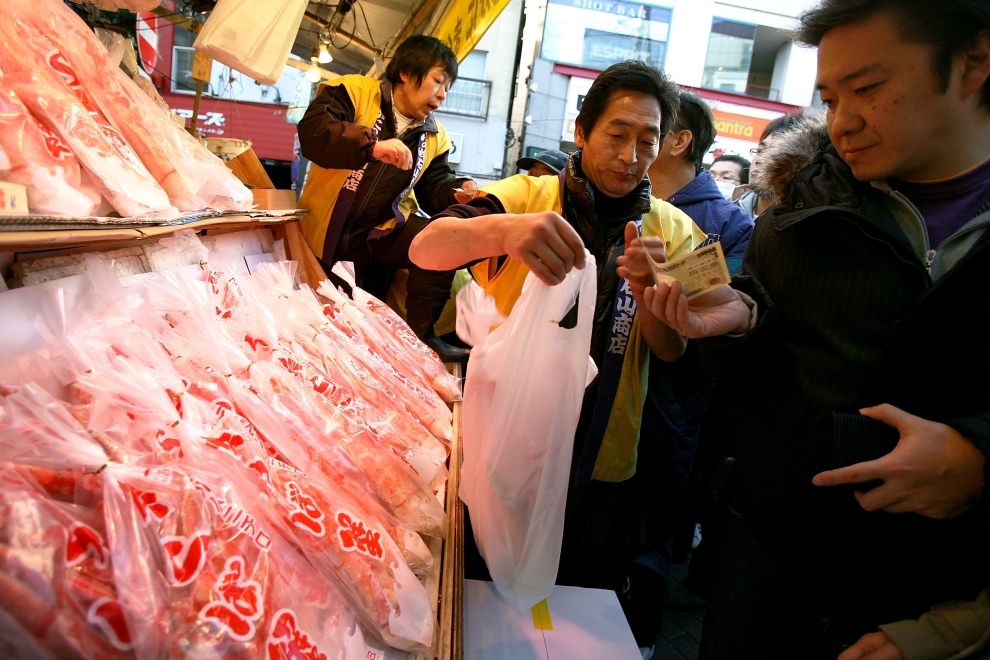
23 Tray, which laid packaged seafood for private buyers. (Photo: Kiyoshi Ota / Getty Images)
2473 Tsukiji Fish Market
24 Sellers advertise their products. (Photo: Kiyoshi Ota / Getty Images)

February 3, 2012

On top of Preikestolen : Norway

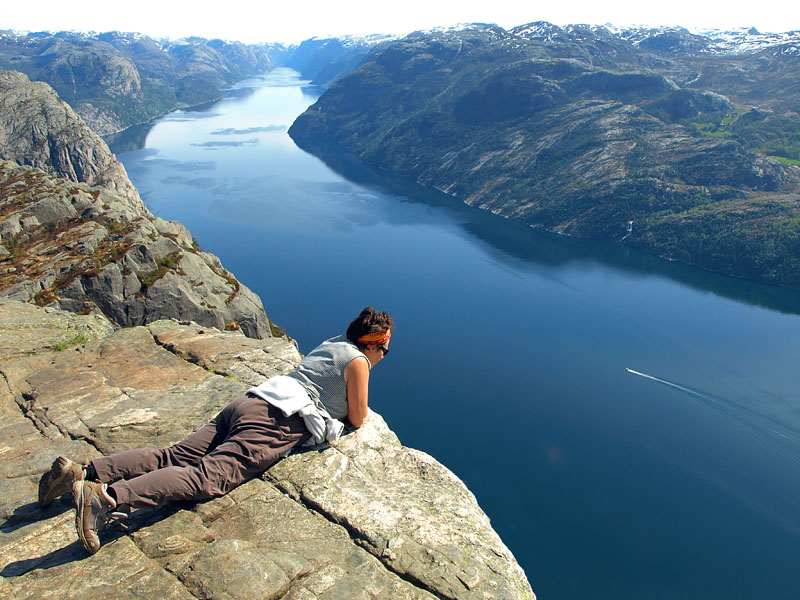
Preikestolen or Prekestolen, also known by the English translations of Preacher’s Pulpit or Pulpit Rock, and by the old local name Hyvlatonnå, is a massive cliff 604 metres (1982 feet) above Lysefjorden, opposite the Kjerag plateau, in Forsand, Ryfylke, Norway. The top of the cliff is approximately 25 by 25 metres (82 by 82 feet) square and almost flat, and is a famous tourist attraction in Norway. (wikipedia)


January 30, 2012

Egyptians Memories รำลึกการเรียกร้องประชาธิปไตยของชาวอิยิปต์

Egyptians gather in Tahrir Square to mark anniversary of uprising


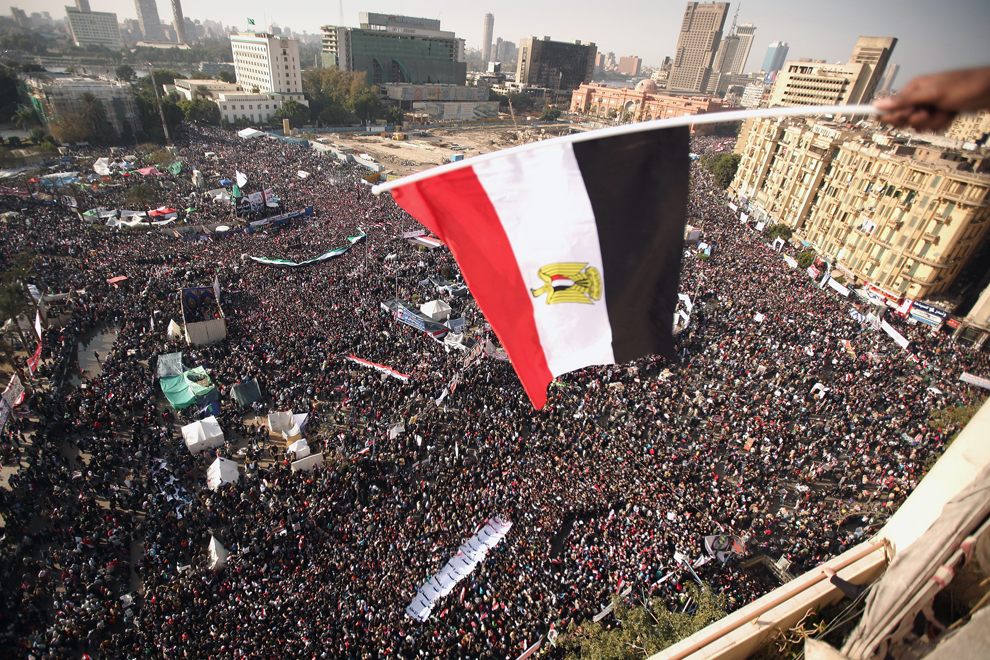
A massive demonstration of Egyptians gathered in Tahrir Square in Cairo today to mark the anniversary of the uprising that eventually led to the ousting of President Hosni Mubarak. Political divides are still in force with liberals and Islamists differing on their visions for the future of the country. Mubarak is now on trial for complicity in the deaths of protesters. The uprising in Egypt last year was one of the initial protests of what is called the Arab Spring, which has included the slaying of Libyan leader Moammar Khadafy and the ongoing protests in Syria. -- Lloyd Young (31 photos total)


Egyptians gather in their thousands in Tahrir Square to mark the one year anniversary of the revolution on Jan. 25, 2012 in Cairo Egypt. Tens of thousands have gathered in the square on the first anniversary of the Arab uprising which toppled President Hosni Mubarak. (Jeff J Mitchell/Getty Images)

January 28, 2012

Landscapes with roads

SOURCE: bicpicture.ru

The road, the road, you know so much about my life difficult. dear, dear, there is not much th soon come home ...


5129 Landscapes from roads